
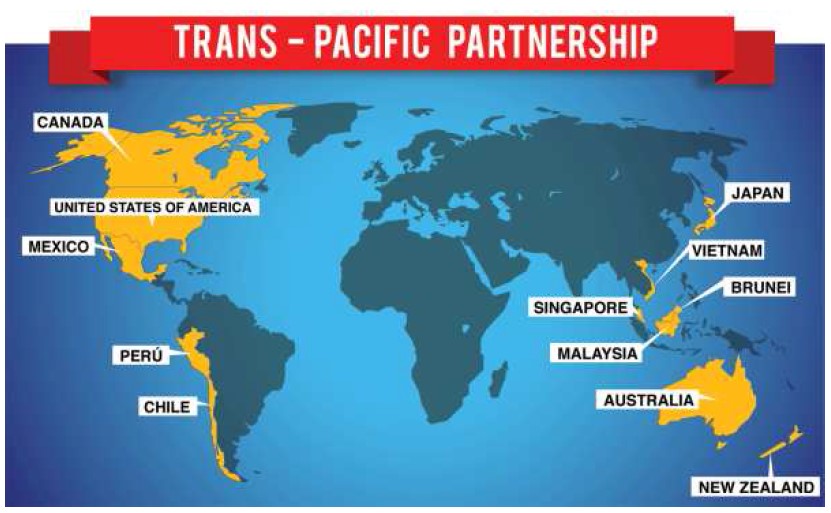

The world’s biggest multinational trade deal was signed by 12 member nations of the Trans-Pacific Partnership (TTP) in Auckland, New Zealand. The Agreement aims to create a single market system as to encourage trade and investment similar to that of the European Union.  Key Highlights
- The TPP deal will cover 40 percent of the world economy.
- The TPP undertake a two-year agreement period in which at least six countries must approve the final text for the deal to be implemented.
- Its objective is to lower taxes on goods and services while regulating commercial laws for two-fifths of the world economy.
About Trans-Pacific Partnership
- TheTrans-Pacific Partnership (TPP) is a trade agreement among twelve Pacific bordered
- It was drafted on 5 October 2015.
- The Member countries of TPP are Australia, Brunei, Canada, Chile, Japan, Malaysia, Mexico, New Zealand, Peru, Singapore, the United States and Vietnam.
The agreement’s aims to
- Promote economic growth
- Support the creation and retention of jobs
- Enhance innovation- productivity and competitiveness
- Raise living standards
- Reduce poverty in our countries and promote transparency
- Good governance and enhanced labour and environmental protections.
- The TPP Agreement was drafted to measures the trade barriers like taxes and mechanism to solve investor-state dispute.
- The United States governmenthas considered the TPP as an agreement to the proposed Transatlantic Trade and Investment Partnership (TTIP) similarly like agreement between the United States and the European Union.
AffairsCloud Recommends Oliveboard Mock Test
AffairsCloud Ebook - Support Us to Grow
Govt Jobs by Category
Bank Jobs Notification