

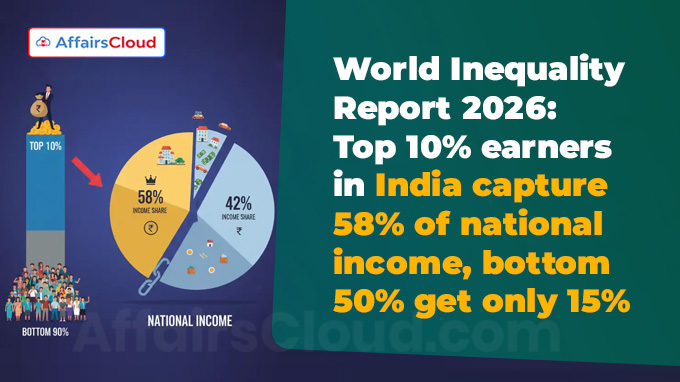
In December 2025, World Inequality Lab (WIL) released the 3rd edition of the World Inequality Report(WIR 2026), tracking the evolution of economic disparities. According to the report, the top 10% of earners in India capture 58% of total income, while the bottom 50% share only 15%, highlighting extreme income disparity.
- In India, the top 10% own around 65% of total wealth, with the top 1% holding about 40%. The average per capita income is approximately 6,200 euros (PPP), and average wealth is about 28,000 euros.
- Women in India earn only 18% of labor income and have low workforce participation, below global averages of 34% income and 51% employment.
Exam Hints:
- What? Release of World Inequality Report 2026
- Who? World Inequality Lab
- Edition: 3rd
- Methodology: Based on WID.world database
- India-Specific Findings:
- Top 10% of earners capture 58% of total income; bottom 50% share 15%
- Top 10% own 65% of wealth, top 1% hold 40%
- Women earn 18% of labor income with low workforce participation
- Global Wealth Inequality:
- Top 10% earn more than bottom 90% combined; hold 75% of global wealth
- Bottom 50% hold only 2%
- Gender Inequality: Women earn 32% of men’s earnings per hour
About World Inequality Report(WIR):
Overview: The World Inequality Report is a global analysis of income and wealth inequality, produced by the World Inequality Lab.
Publication Cycle: New editions of the report are released roughly every four years, with the first edition published in 2018.
Methodology: The report uses the WID.world database, evolved from the World Top Incomes Database, which compiles global tax records, national accounts, and survey data to provide harmonised estimates of income and wealth distribution.
WIR 2026: It is compiled by over 200 researchers in the WIL and presents the latest data and insights on global inequality across income, wealth, gender, climate impact, taxation, politics, and access to opportunities.
Highlights of WIR 2026 :
Overview: The report highlights inequality remains extremely high, different types of inequalities are connected and strengthen each other, and inequality affects democratic systems, weakening unity and reducing political agreement.
Global Inequality: The global inequality remains high, with 10% earning more than the bottom 90% combined and owing about 75% of global wealth. The bottom 50% hold just 2%.
- About 0.001% (approximately 60,000 people), holds three times the wealth of the entire bottom 50% of the human population.
Climate Inequality: The poorest 50% of the world produce only 3% of emissions from private capital and 10% of emissions from consumption. The richest 10% produce 77% of emissions from private capital and 47% of consumption-based emissions.
- The top 1% alone are responsible for 41% of private capital emissions, almost twice as much as the entire bottom 90% combined.
- People in low-income countries, who contribute the least to the crisis, face the highest risk from climate disasters, including floods, droughts, and heatwaves. High emitters, mostly wealthy individuals and countries have more resources to adapt and protect themselves.
Gender Inequality: Globally, women receive just over 25% of total labor income, encompassing Middle East & North Africa(MENA) (16%), South & Southeast Asia (20%), Sub-Saharan Africa (28%), East Asia (34%), Europe, North America & Oceania, Russia & Central Asia (40%).
- Women earn much less than men when paid and unpaid work are included. Women earn 32% of men’s earnings per hour including unpaid care or domestic work and 61% when unpaid work is excluded.
Inequality Between Regions: The high-income areas, including North America, Oceania, and Europe earn far more than regions such as Sub-Saharan Africa, South & Southeast Asia, and Latin America.
- An average person in North America & Oceania earns 13 times more than someone in Sub-Saharan Africa. In each region, the top 10% take much more income and wealth than the bottom 50%, with wealth being more concentrated at the top.
- The United States of America (USA), Latin America, Southern Africa, and the Middle East & North Africa show the highest inequality.
Redistribution, Taxation, and Evasion: Progressive taxes and welfare transfers significantly reduce inequality in regions such as Europe and North America, where they cut income gaps by 30%.
- The inequality in education spending remains huge, a child in Sub-Saharan Africa receives only 220 Euro compared to 7,430 – 9,020 Euros in Europe and North America.
Inequality in the Global Financial System: It is structured in a way that automatically benefits rich countries and disadvantages developing countries. Countries that issue reserve currencies can borrow cheaply, lend at higher rates, and attract global savings.
- Wealthy countries earn more from global investments while paying less to borrow.
About World Inequality Lab (WIL):
Scientific Co-Director – Facundo Alvaredo
Headquarters – Paris, France
Established – 2016.