

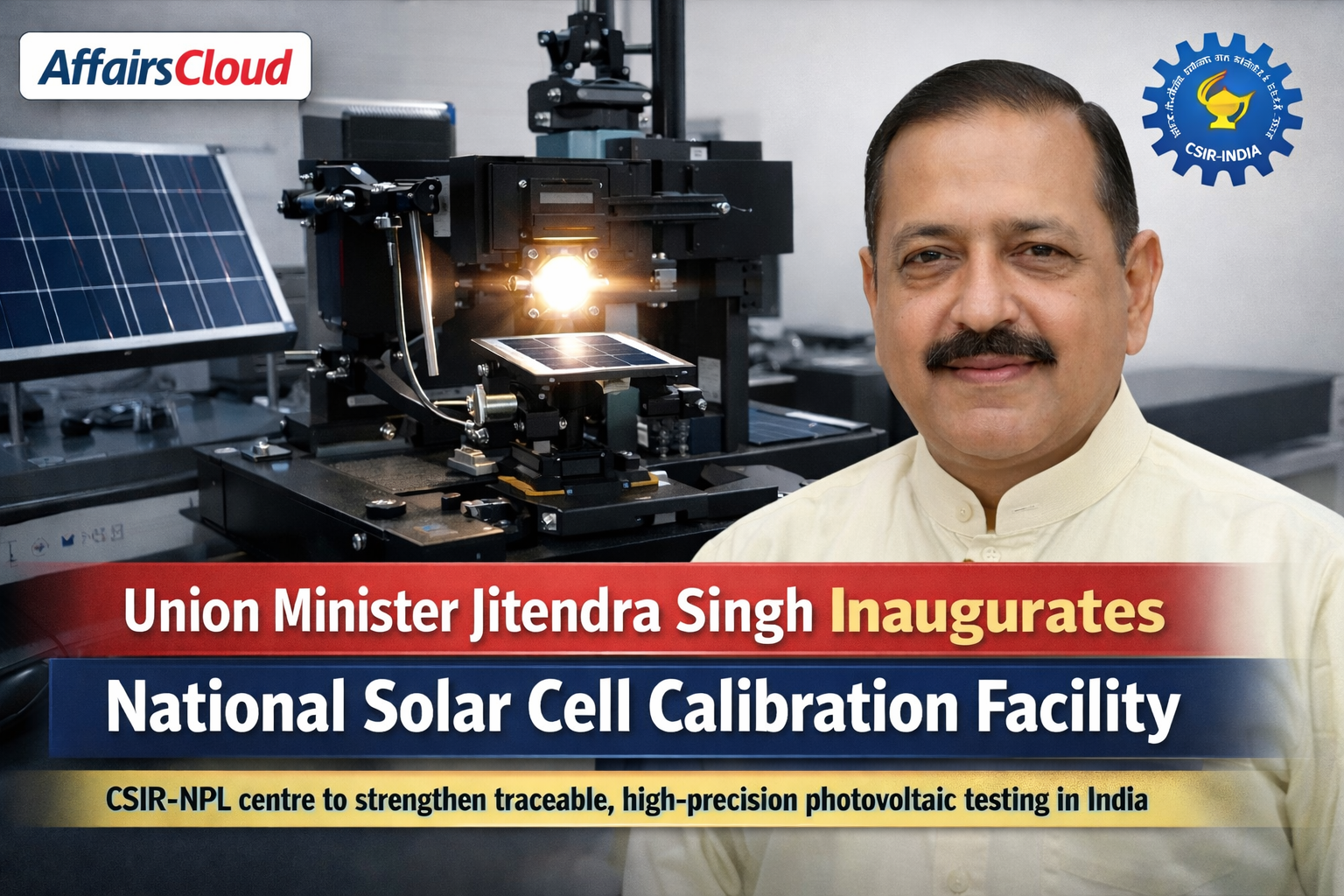
On January 5, 2026, Union Minister of State(MoS) Independent Charge (IC) Dr. Jitendra Singh, Ministry of Science and Technology (MoS&T), inaugurated National Environmental Standard Laboratory (NSEL), second-of-its-kind in the world, and National Primary Standard Facility for Solar Cell Calibration, world’s fifth-of-its-kind, at Council of Scientific and Industrial Research – National Physical Laboratory (CSIR-NPL) campus in New Delhi(Delhi), during its 80th Foundation Day celebrations.
Exam Hints:
- What? Inaugurates Two World-Class Laboratories
- Who? Union Minister Independent Charge (IC) Dr. Jitendra Singh, (MoS&T)
- Where? At CSIR-NPL in New Delhi (Delhi)
- Key Inaugurations:
- National Environmental Standard Laboratory, Asia’s first, world’s second pollution monitoring lab;
- National Primary Standard Facility for Solar Cell Calibration, World’s 5th
- Other launches: 14 Phytochemical BNDs, 2 Gas BNDs, and 1 Silica Fume BND
About National Environmental Standard Laboratory(NSEL):
Certification: The facility is Asia’s first and the world’s second pollution monitoring facility after the United Kingdom(UK). It is designed to test, calibrate, and certify air pollution monitoring devices, strengthening domestic capabilities and reducing reliance on foreign certification agencies.
Data Accuracy: It supports accurate and transparent environmental data for programmes, including National Clean Air Programme(NCAP) and helps regulators, industries and startups improve compliance and enforcement.
Testing: The lab’s services will support regulators, industry, and startups by ensuring reliable performance testing of systems such as Continuous Ambient Air Quality Monitoring System (CAAQMS) and Online Continuous Emission Monitoring Systems (OCEMS).
Air Quality Monitoring Facilities and Systems:
- PM Testing: For particulate matter (PM) testing, only Germany has a comparable facility worldwide, besides India.
- CAAQMS: It is a fixed, automated station that continuously measures ambient (outdoor) air quality in cities and industrial areas.
- OCEMS: It is a real-time monitoring system installed at industrial stacks and chimneys to continuously measure pollutants released by industries.
About National Primary Standard Facility for Solar Cell Calibration:
Collaboration: It was developed in collaboration with Physikalisch-Technische Bundesanstalt (PTB), Germany and uses a Laser-based Differential Spectral Responsivity (L-DSR) system.
Performance: It achieves the world’s lowest calibration uncertainty (0.35%)k=2 and reduces dependence on foreign certification, saves foreign exchange and boosts investor confidence in India’s solar sector.
Other 4 Laboratories : Four international laboratories are recognized under the World Photovoltaic Scale (WPV) for high-precision solar cell calibration. These include the National Renewable Energy Laboratory (NREL) in the United States of America(USA), PTB in Germany, AIST in Japan, and the Tianjin Institute of Power Sources (TIPS) in China.
Other Launches:
Reference Materials: During the event, 14 Phytochemical Bharatiya Nirdeshak Dravya (BNDs), 2 Gas BNDs, and 1 Silica Fume BND were released, aimed at strengthening India’s quality and measurement standards.
MoUs signed: Several Memorandum of Understanding(MoUs) and technology transfer agreements were signed to promote indigenous manufacturing and provide support to startups and Micro, Small, and Medium Enterprises(MSMEs).
About Council of Scientific and Industrial Research – National Physical Laboratory (CSIR-NPL):
CSIR-NPL is India’s premier metrology (measurement science) institute, responsible for maintaining national standards of measurements. It ensures accuracy, uniformity, and traceability of measurements across India.
Director – Professor Venu Gopal Achanta
Headquarters – New Delhi, Delhi
Established – 1947