

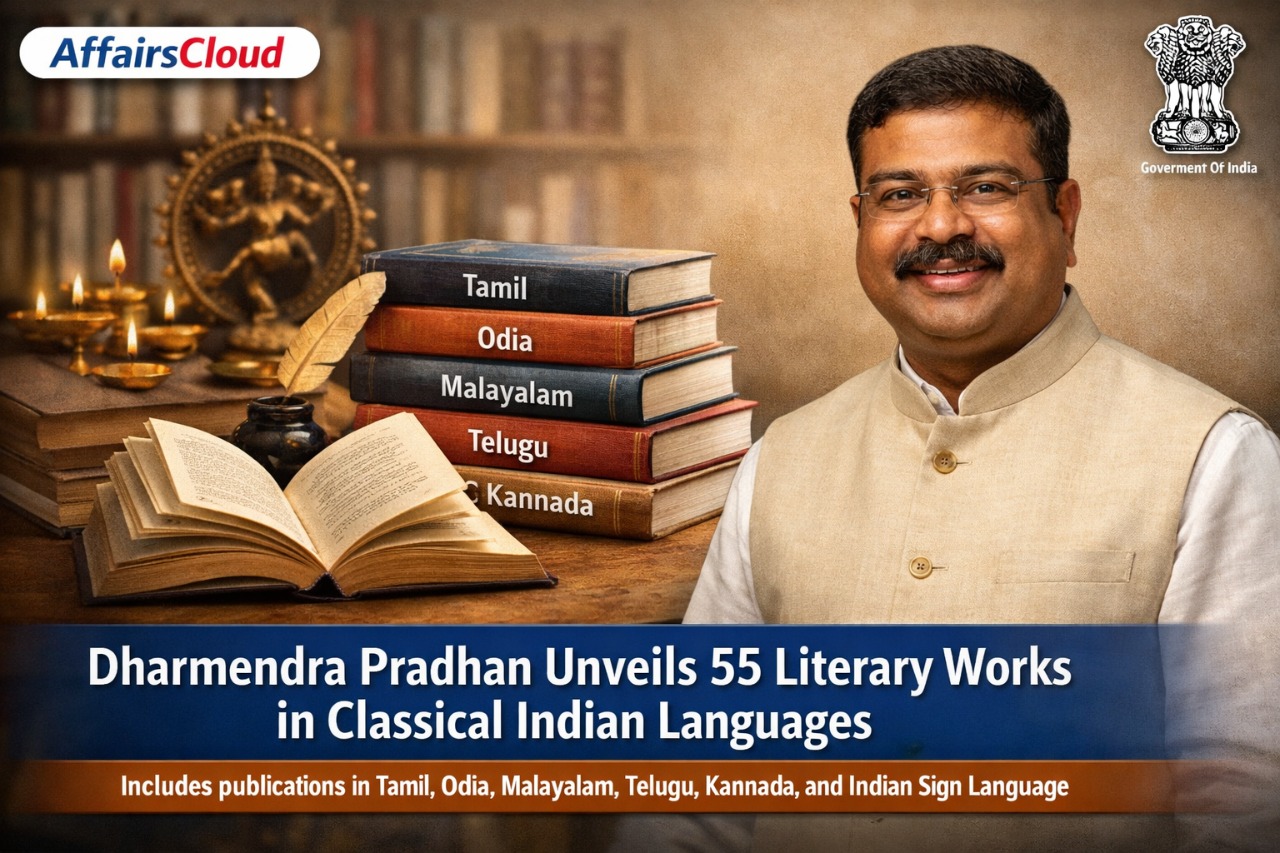
On 6th January 2026, Union Minister Dharmendra Pradhan, Ministry of Education (MoE), released 55 scholarly literary works in classical Indian languages at an event held in New Delhi, Delhi, to promote India’s linguistic heritage and inclusive access to classical knowledge.
- This compilation includes literary works in Kannada, Telugu, Malayalam, Odia, and Tamil, along with an Indian Sign Language (ISL) interpretation of the Tirukkural.
- The event was graced by Vineet Joshi, Secretary (Higher Education), MoE; Chamu Krishna Shastry, Chairman, Bharatiya Bhasha Samiti (BBS); Prof. Shailendra Mohan, Director, Central Institute of Indian Languages (CIIL); Prof. R. Chandrasekaran, Director, Central Institute of Classical Tamil (CICT); Ms. Manmohan Kaur, Advisor (Cost), along with other senior officials from the MoE.
Exam Hints:
- What? Release of 55 literary works in classical Indian languages
- Who? Union Minister Dharmendra Pradhan, MoE
- Where? New Delhi, Delhi
- Languages Covered: Tamil, Kannada, Telugu, Malayalam, Odia, Indian Sign Language
- Literary Works:
- 41 books by CIIL’s CoE covering Kannada, Telugu, Malayalam, and Odia
- 13 books by CICT on Tamil and Tirukkural Sign Language series
- Purpose: Promote India’s linguistic heritage, accessibility of classical knowledge
- Alignment: NEP 2020
About Literary Works:
Publications: A total of 41 books were developed by the Centres of Excellence(CoE) for Classical Languages under the CIIL, Mysuru(Karnataka), an autonomous body under the MoE for research, promotion, and documentation of Indian languages.
- These works cover Classical Kannada, Telugu, Malayalam, and Odia.
- English and Hindi translations of ‘Madalapanji’ by JK Nayak and Surendra Panigrahi, the English translation of ‘Rudrasudhanidhi’ by Gangadhar Panda and Pramodini Panda, ‘Shilpa Shabdabali’ by Debi Prasanna Nanda, and ‘Charyapada’ by Santosh Kumar Mohapatra were also released.
Tamil Works: The Central Institute of Classical Tamil (CICT), Chennai, Tamil Nadu (TN), an autonomous institution under the MoE dedicated to classical Tamil language and literature, released 13 books and a Tirukkural Sign Language series.
Tirukkural Sign Language series: A 45-episode Sign Language interpretation series of the classical Tamil text Tirukkural, authored by Thiruvalluvar and containing couplets on ethics, governance, economy, and love, was launched to promote inclusive education and ensure access to classical wisdom for persons with hearing disabilities.
Alignment: The initiative aligns with the National Education Policy (NEP) 2020 by promoting education in Indian languages and underscores the preservation of linguistic and cultural heritage as vital to achieving Viksit Bharat 2047.
Transformation: Professional courses in engineering, medicine, and law are being developed in Indian languages to move beyond the colonial Macaulay mindset, alongside the translation and digitization of classical texts to strengthen India’s linguistic ecosystem.
Classical Languages of India:
Criteria: A language qualifies as classical if it has ancient texts (1,500–2,000 years old), a heritage literature valued across generations, knowledge texts including prose, poetry, and inscriptions, and its classical form may differ from modern derivatives.
Classical Languages: India currently recognizes 11 classical languages: Tamil (2004), Sanskrit (2005), Kannada (2008), Telugu (2008), Malayalam (2013), Odia (2014), and five new additions in 2024: Marathi, Pali, Prakrit, Assamese, and Bengali.
About Ministry of Education (MoE):
Union Minister- Dharmendra Pradhan (Constituency- Sambalpur, Odisha)
Minister of State (MoS)– Jayant Chaudhary (Rajya Sabha- Uttar Pradesh, UP); Dr. Sukanta Majumdar (Constituency- Balurghat, West Bengal, WB)