

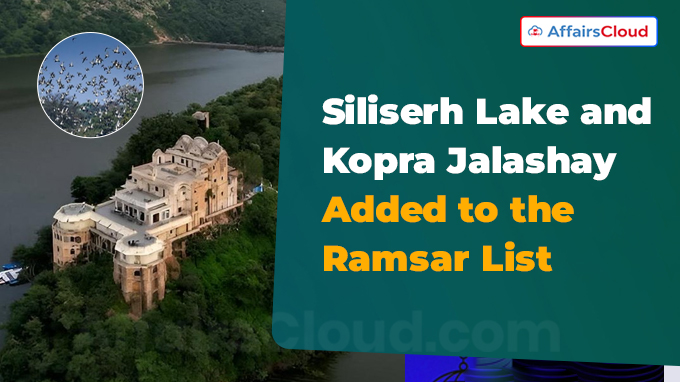
In December 2025, India included Siliserh Lake in Alwar district, Rajasthan and Kopra Jalashay near Bilaspur in Chhattisgarh in the List of Wetlands of International Importance (Ramsar List) under the Ramsar Convention on Wetlands, 1971, as its 95th and 96th Ramsar Sites, increasing the country’s total number of Ramsar Sites to 96.
- With this inclusion, Rajasthan now has 5 Ramsar Sites, while Chhattisgarh records its first-ever Ramsar Site.
Exam Hints:
- What: Two new wetlands added to Ramsar List
- New Sites: Siliserh Lake (Rajasthan) and Kopra Jalashay (Chhattisgarh’s 1st site)
- Total Ramsar Sites in India: 96
- Governing Convention: Ramsar Convention on Wetlands, 1971
- States with highest number of sites: TN (20), UP (10) and Bihar (6)
- World’s Top Ramsar Countries: UK (176), Mexico (144), India (96)
- Largest Ramsar Site in India: Sundarban Wetland in WB
- Smallest Ramsar Site in India: Renuka Lake in HP
About Siliserh Lake, Rajasthan:
Overview: Siliserh Lake is a human-made freshwater lake, built in 1845 by Maharaja Vinay Singh to supply drinking water to Alwar city, located about 8 miles southwest of the city within the buffer zone of the Sariska Tiger Reserve.
Climate & Area: Siliserh Lake lies in a semi-arid region and covers about 7 square kilometres (sq km) or (km²).
Biodiversity: The wetland supports 149 bird species and 17 mammal species, including notable species such as the vulnerable river tern (Sterna aurantia), the endangered tiger (Panthera tigris), and over 1% of the biogeographic population of the black stork (Ciconia nigra).
Conservation Measures: The lake faces threats from intensive agriculture and expanding human settlements, and a restoration plan is being implemented to protect its ecological and hydrological functions.
Kopra Jalashay, Chhattisgarh:
Location: Kopra Jalashay is a reservoir-type wetland, originally constructed for irrigation, located near Bilaspur in the upper catchments of the River Mahanadi and surrounded mainly by farmland and a few villages.
Biodiversity: Kopra Jalashay, a reservoir-type wetland originally constructed for irrigation, supports more than 60 migratory bird species and is home to notable species such as the vulnerable greater spotted eagle (Aquila clanga) and the endangered Egyptian vulture (Neophron percnopterus).
Conservation: Kopra Jalashay is threatened by siltation, invasive species, and intensive agriculture, while proposed conservation measures await implementation through a formal management plan.
Ramsar Sites in World:
Total Sites: As of 15 December 2025, there are 2,550 Ramsar Sites worldwide.
World’s First: The world’s first Ramsar Site was Cobourg Peninsula in Australia, designated in 1974.
Largest Site: The Rio Negro in Brazil is the largest Ramsar Site, covering approximately 120,000 sq km (12 million hectares).
Smallest Site: The Monaco Marine Reserve in Monaco is the smallest Ramsar Site, with an area of just 0.04 hectares.
Ramsar Sites in India:
Total Sites: India now hosts 96 Ramsar Sites, covering an area of approximately 1,362,205.63 hectares.
Global Rank: With the latest additions, India holds the highest number of Ramsar Sites in South Asia, ranks first in Asia, and stands third globally after the United Kingdom(UK) (176 sites) and Mexico (144 sites).
India’s 1st Sites: Chilka Lake (Odisha) and Keoladeo National Park (NP) (Rajasthan) were designated as India’s first Ramsar Sites in 1981.
Top Ramsar States: Tamil Nadu (TN) has 20 Ramsar Sites, followed by Uttar Pradesh (UP) with 10 sites and Odisha with 6 sites, making them the top three states in India by number of Ramsar Sites.
Largest Ramsar Sites in India: The Sundarban Wetland in West Bengal (WB) is the largest Ramsar Site in India, covering an area of 4,230 km².
Smallest Ramsar Sites in India: Renuka Lake in Himachal Pradesh is the smallest Ramsar Site in India, with an area of just 0.2 km².
Newly Added Ramsar Sites in 2025: In 2025, India added 11 new Ramsar Sites across several states, including Sakkarakottai and Therthangal Bird Sanctuaries (TN), Khecheopalri Wetland (Sikkim), Udhwa Lake (Jharkhand), Khichan and Menar (Rajasthan), Gokul Jalashay, Udaipur Jheel, and Gogabeel Lake (Bihar), Siliserh Lake (Rajasthan), and Kopra Jalashay (Chhattisgarh).
About Ramsar Convention on Wetlands:
The Ramsar Convention on Wetlands, an international treaty for wetland conservation and sustainable use, was adopted in 1971 in Ramsar, Iran, came into force in 1975, and India acceded to it on 1 February 1982.
Secretary-General (SG)- Dr. Musonda Mumba
Headquarters – Gland, Switzerland.