

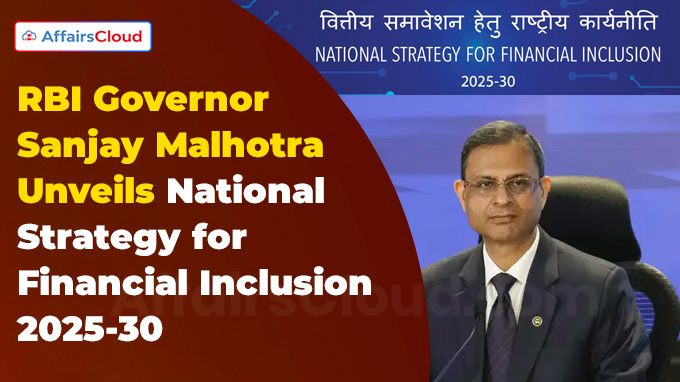
In December 2025, the “National Strategy for Financial Inclusion (NSFI):2025-30”, approved by the Sub-committee of the Financial Stability and Development Council (FSDC-SC) in its 32nd meeting, was formally released by Sanjay Malhotra, Governor, Reserve Bank of India (RBI).
Exam Hints:
- Document released: NSFI 2025-30
- Released By: RBI
- 5 Objectives: Panch-Jyoti –
- Expanding equitable and affordable services (13 AP),
- Promoting women-led inclusion (6 AP),
- Linking finance with livelihoods (7 AP),
- Leveraging financial education (10 AP), and
- Strengthening customer protection (8 AP).
- Action Points: 47
Key Highlights
Vision: To strengthen the financial inclusion ecosystem through coordinated efforts of all stakeholders, ensuring access to equitable, responsible, suitable, and affordable financial services for all.
- This will be supported by livelihood enablers, strong financial literacy, reliable digital public infrastructure, and robust customer protection mechanisms.
SDG (Sustainable Development Goals): The timeline of NSFI: 2025-30 is synchronized with the 2030 Agenda for Sustainable Development adopted by 193 Member States at the United Nation General Assembly (UNGA) Summit in September 2015.
- The 2030 Agenda for Sustainable Development Goals adopted by United Nation members identified Financial Inclusion as a key enabler for 7 out of 17 goal.
Objectives: The strategy of NSFI 2025-30 is anchored in five objectives, termed “Panch-Jyoti” supported by 47 action points: Expanding equitable and affordable services, promoting women-led inclusion, linking finance with livelihoods, leveraging financial education, and strengthening customer protection.
Developed: The NSFI 2025-30 has been developed under the Technical Group on Financial Inclusion and Financial Literacy (TGFIFL), following consultations nationwide with multiple stakeholders.
- NSFE laid down “5-C Approach” Content, Capacity, Community, Communication strategy and Collaboration among various stakeholders.
Objective 1
Improving the availability and use of Equitable, Responsible, Suitable, and Affordable Bouquet of Financial Services to achieve Financial Safety and Financial Security for households and micro enterprises.
Action Points:
- Improving equity, reach, consistency, and quality of last mile access: Ensuring availability of at least one banking outlet – branch /digital banking unit (DBU)/ fixed point business correspondent outlet (FBC) in each revenue centre.
- Incentive mechanism for BC (Business Correspondent) agents from hilly and rural areas: The current Financial Inclusion Fund (FIF) incentive for BCs in Tier V and Tier VI centres of North-Eastern (NE) States and other Hilly States and Union Territories (UTs) may be expanded to include all Fixed-Point BCs operating in Tier VI centres across India.
- Expanding Digital Financial Services:
UPI (Unified Payment Interface): Goal of reaching one billion (bn) users in digital payments ecosystem by December 2029.
Expanding and Deepening Digital Payment Ecosystem (EDDPE): Providing every eligible individual in identified districts at least one mode of digital payments.EDDPE should aim to achieve – (i) 100% coverage in 80% of districts by March 2026, and (ii) 100% coverage in all identified districts by March 2027.
Programmable Central Bank Digital Currency (CBDC) to Facilitate Targeted Credit Flow and Expand Access: This may be leveraged to facilitate credit flow to underserved segments like tenant farmers, micro enterprises, etc.
Unified Lending Interface (ULI): This will be rolled out in a phased manner to enable delivery of frictionless credit by facilitating seamless flow of required digital information to digital lenders.
Onboarding of all banks and insurance companies to Jansuraksha Portal and improving coverage of Atal Pension Yojana (APY): The portal provides access to Social security Insurance schemes and also enrolments, claims under the Pradhan Mantri Suraksha Bima Yojana (PMSBY), and Pradhan Mantri Jeevan Jyoti Bima Yojana (PMJJBY).
- Simpler Digital Interface and Use of AI (Artificial Intelligence): Awareness of AI-based language tools like Bhashini should be increased among users and financial service providers to enable their integration into financial services.
- Micro Enterprises to receive focussed attention
- Role of Self-Regulatory Organisations (SRO)
Objective 2
Adopting Gender-Sensitive Approach for Women-led Financial Inclusion and Differentiated Strategies for Improving Financial Resilience of Households, especially the Underserved and Vulnerable Segments.
Action Points:
- Increasing the share of women BC: The goal would be to ensure at least 30% share of women BCs by December 2028 from the current level of around 15%.
Objective 3
Synergizing Livelihood, Skill Development and Support Ecosystem and its linkages with Financial Inclusion.
Action Points:
- Content Development and Delivery for Skill Training: Adoption of National Skills Qualifications Framework (NSQF) and gender-sensitive approach by all skill training institutions.
- Data sharing and Reporting: National Skill Development Corporation (NSDC) should use the Skill India Digital Hub to publish regular reports on skill training activities and outcomes.
Objective 4
Leveraging Financial Education as a Tool for Promoting Financial Discipline.
Action Points:
- Sustaining and deepening financial literacy initiatives
- Targeted Financial Literacy Initiatives
- Improving Digital Literacy
- Development and dissemination of content on areas of emerging relevance
- Periodic Assessment of the state of financial literacy
- Developing AI & Machine Language (ML) -based public query systems on common banking and finance-related aspects
Objective 5
Strengthening the Quality and Reliability of Customer Protection and Grievance Redressal Measures.
Action Points:
- Improving Grievance Redress Mechanism – Effective use of Citizen Financial Cyber Frauds Reporting and Management System (CFCFRMS) to attend cyber fraud complaints, Board approved Customer Grievance Redress Policy.
- Strengthening Customer Protection Measures: Digital Payments Intelligence Platform (DPIP) to Mitigate Payment Frauds, Protection against dark patterns, Use of pre-intimated official phone numbers by banks, Conduct of regular customer awareness campaigns.
India’s Financial Inclusion Gains Momentum
FI-Index: Financial Inclusion Index risen to 67 in 2025, up by 24.3% since 2021, FI-Index is based on 97 indicators and has 3 sub-indices, “Access”, “Usage” and “Quality”, with each sub-index having respective weight of 35, 45 and 20 per cent respectively.
The Global Findex 2025 highlighted that account ownership in India has reached to 89 per cent since 2011
- Universal access to financial services: The objective is to provide access to a formal financial service provider to every village within a distance of 5km radius and the onboarding process should be hassle free, digital and less use of paper.
India’s Key Initiatives for Financial Inclusion:
- Pradhan Mantri Jan Dhan Yojana
- Pradhan Mantri Suraksha Bima Yojana
- Pradhan Mantri Jeevan Jyoti Bima Yojana
- Atal Pension Yojna
- Pradhan Mantri MUDRA Yojana
- Stand Up India Scheme
- Unified Payments Interface
- Mahila Sammriddhi Yojana
- Kisan Credit Card