

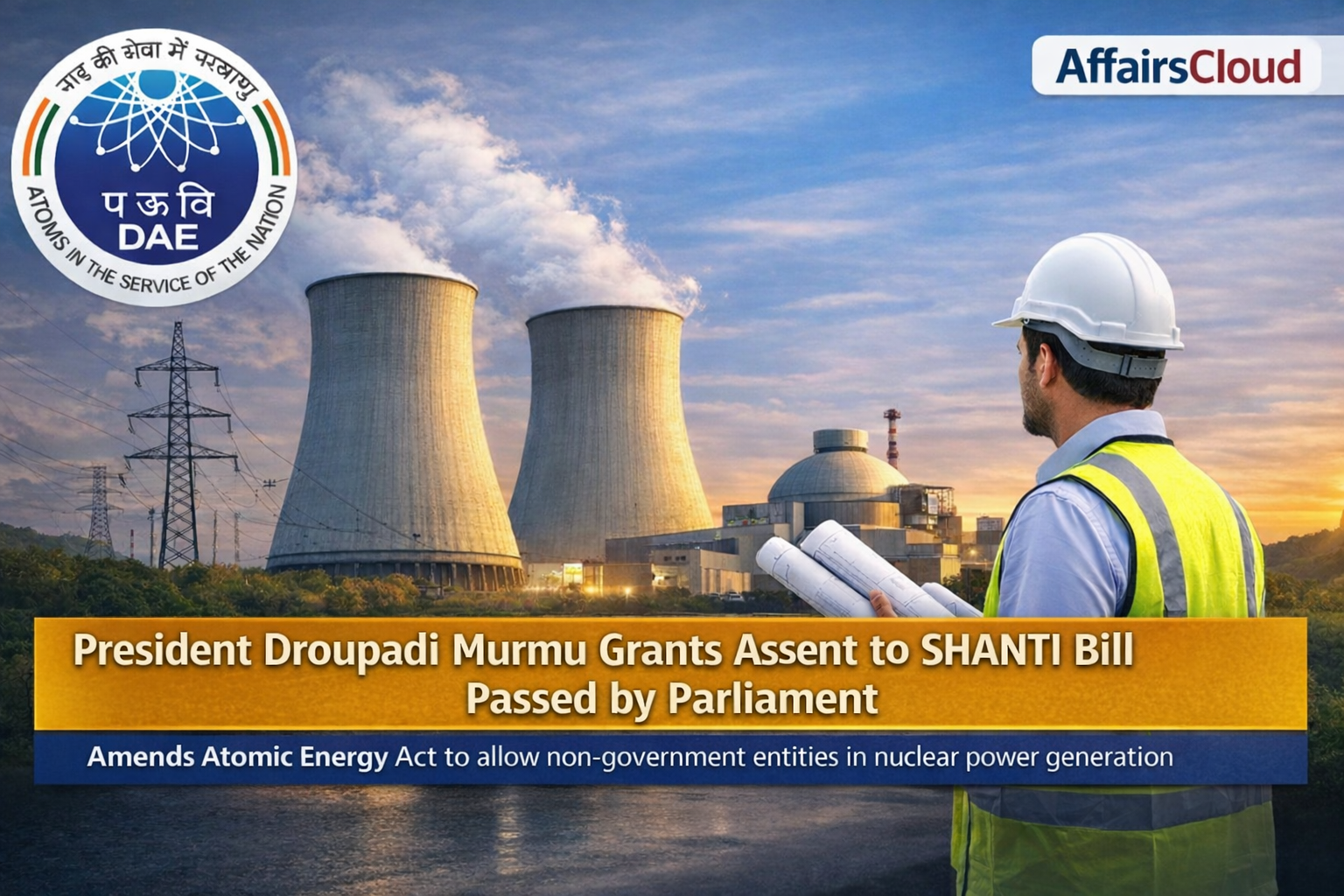
In December 2025, President Droupadi Murmu has granted assent to the Sustainable Harnessing and Advancement of Nuclear Energy for Transforming India (SHANTI) Bill, 2025, which was passed by both houses of Parliament.
- The SHANTI Act, 2025 allows private companies and Joint Ventures(JV) to build, own, operate, and decommission nuclear power plants under government licensing and regulatory oversight.
Exam Hints:
- What? President Droupadi Murmu granted assent to the SHANTI Bill, 2025
- Introduced by: MoS Jitendra Singh, DAE and MoS&T
- Purpose: Enable private sector participation; establish a comprehensive legal framework
- Legal Changes: Amends the Atomic Energy Act, 1962, and the Civil Liability for Nuclear Damage Act (CLNDA), 2010
- FDI: Up to 49% allowed
- Grants statutory status: AERB
- Current Operator: NPCIL
Background:
Introduced by: Union Minister of State (MoS) Jitendra Singh, Department of Atomic Energy (DAE), Ministry of Science & Technology(MoS&T), introduced the Sustainable Harnessing and Advancement of Nuclear Energy for Transforming India (SHANTI) Bill, 2025, after prior approval from the Union Cabinet chaired by Prime Minister (PM) Narendra Modi.
Legal Reform: The Bill seeks to replace the Atomic Energy Act, 1962 and the Civil Liability for Nuclear Damage (CLND) Act, 2010, and open India’s nuclear power sector to private and foreign participation.
Atomic Energy Amendment Bill (2015): Under the Atomic Energy Act, 1962, nuclear power operations in India were confined to state-run entities, primarily Nuclear Power Corporation of India Limited (NPCIL) and Bharatiya Nabhikiya Vidyut Nigam Limited (BHAVINI), both under the administrative control of the DAE.
- The 2015 Amendment allowed NPCIL to form JV with other public sector undertakings (PSUs), expanding collaboration within the nuclear sector but only among government entities, without permitting private sector participation.
About Atomic Energy Bill, 2025 (SHANTI):
Vision: Seeks to expand India’s nuclear power capacity from about 8.9 gigawatt (GW) to 100 GW by 2047 to support clean energy goals, ensure energy security, and contribute to the net-zero target by 2070.
Activities Reserved for Government: Key functions such as uranium and thorium mining, fuel enrichment, isotopic separation, spent-fuel reprocessing, high-level radioactive waste management, and heavy water production will remain under exclusive central government or state-owned control.
Private Participation: Ends NPCIL’s monopoly by allowing licensed private companies and JV to participate across the nuclear value chain including mining, fuel fabrication, equipment manufacturing, reactor development, and support infrastructure.
FDI Policy: The Bill permits Foreign Direct Investment (FDI) up to 49% in the nuclear power sector.
Liability Reform: The SHANTI Bill introduces a capacity-based, capped liability regime, removes supplier liability, limits operator penalties to Rs.1 crore, and mandates insurance or financial security up to Rs.1,500 crore per incident.
Nuclear Liability Limits: Operator liability is capped based on plant size: above 3,600 Megawatt(MW) – Rs.3,000 crore, 1,500–3,600 MW – Rs.1,500 crore, and up to 150 MW – Rs.100 crore, with a specialised nuclear tribunal proposed to handle disputes.
Safety and Oversight: It strengthens nuclear safety, emergency preparedness, and safeguards in line with International Atomic Energy Agency (IAEA) standards, while the DAE retains control over nuclear materials, heavy water, and radioactive waste management.
Regulatory Strengthening: Grants statutory status to the Atomic Energy Regulatory Board (AERB), establishes specialised adjudication mechanisms, and restricts civil court jurisdiction for faster dispute resolution.
Strategic Importance: Positions nuclear energy as a reliable 24×7 base-load power source to meet rising demand from industry, digital infrastructure, and Artificial Intelligence (AI)-driven growth.
About India’s Nuclear Power Expansion:
SMR Mission: A Rs.20,000 crore Nuclear Energy Mission(NEM) promotes research, development, and deployment of Small Modular Reactors (SMRs), with five planned by 2033.
Current Status: As of December 2025, India operates 24 reactors with about 8.9 GW capacity, has 17 reactors under construction, and targets 22 GW by 2032.
About Nuclear Power Corporation of India Limited (NPCIL):
Chairman and Managing Director (CMD) – Bhuwan Chandra Pathak
Headquarters – Mumbai, Maharashtra
Established – 1987