

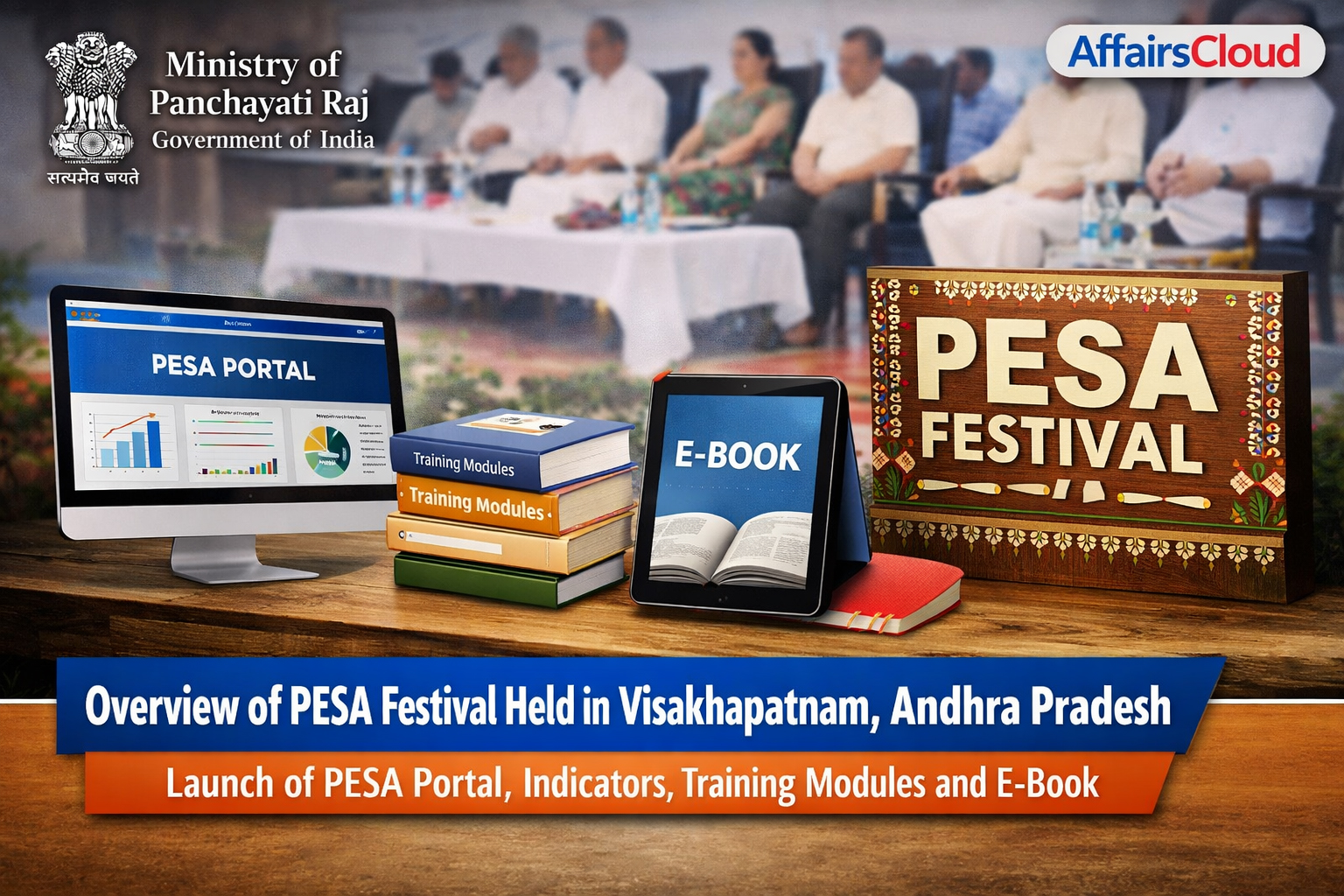
The Ministry of Panchayati Raj (MoPR) celebrated “2025 PESA Mahotsav: Utsav Lok Sanskriti Ka” from December 23 to 24, 2025 at Visakhapatnam Port Authority Stadium in Visakhapatnam, Andhra Pradesh (AP).
- The two-day festival marked the enactment of the Panchayats (Extension to Scheduled Areas) PESA Act, 1996, with PESA Day observed on 24th December each year to commemorate its anniversary.
Exam Hints:
- Event: PESA Mahotsav: Utsav Lok Sanskriti Ka Held
- Venue: Visakhapatnam, AP
- Organised by: MoPR
- Significance: To commemorate the enactment of PESA Act, 1996
- PESA Act Came into Force: On December 24, 1996
- PESA Day: 24th December, 2025
- Official Mascot: Krishna Jinka
- Key Initiatives Launched: PESA Portal; PESA Indicators; Training modules on PESA in tribal languages; and E-book on Kinnaur district of HP
- Host State for 2026: Chhattisgarh
About PESA Mahotsav: Utsav Lok Sanskriti Ka:
Inauguration: The Mahotsav was inaugurated by Mukta Shekhar,
Joint Secretary, MoPR; Krishna Teja, Commissioner of Panchayati Raj and Rural Development, AP; and ace archer Jyothi Surekha Vennam.
Konidala Pawan Kalyan, Deputy Chief Minister and Minister for Panchayati Raj & Rural Development, Government of AP. Vivek Bharadwaj, Secretary, MoPR, along with other senior officials from the central and state governments, also attended the event.
Official Mascot: During the inaugural ceremony, the official mascot of PESA Mahotsav ‘Krishna Jinka’, and PESA Run T-shirts and caps were unveiled.
Key Participants: The Mahotsav saw the participation of around 2,000 representatives from 10 PESA States namely, AP, Chhattisgarh, Gujarat, Himachal Pradesh (HP), Jharkhand, Madhya Pradesh (MP), Maharashtra, Odisha, Rajasthan and Telangana.
PESA Run: The event started with the PESA Run along the iconic Ramakrishna (R.K.) Beach (Visakhapatnam, AP).
- Arjuna Awardee and Renowned Archer, Jyothi Surekha officially flagged off the run, which saw participation from people across all age groups.
- Atul Chidhade (from Maharashtra) secured 1st spot in men’s category; followed by Suraj Mashi and Manoj Hillin (both from Maharashtra), while in women’s category, Raj Kumari (Rajasthan) secured 1st position; followed by Hira Sanga (Jharkhand) and Priya (HP).
Indigenous Traditional Games: Teams from various PESA States showcased their traditional indigenous games such as: Cholo, Yedu Penkulata, Gedi Doud, Rasa Kashi, Uppanna Barelu, Pithool, Sikor, Mallakhamba and Chakki Khel, representing the rich sporting heritage of tribal communities in India.
Special Gram Sabhas: As part of the celebrations, special Gram Sabhas were organised in PESA Gram Panchayats of AP, featuring elected representatives from the 10 participating states.
Key Initiatives Launched: On the concluding day of the Mahotsav, Vivek Bharadwaj, Secretary, MoPR unveiled several key initiatives such as:
- The PESA Portal will be used for dissemination of information and monitoring of PESA implementation;
- PESA Indicators will be used to evaluate the status of implementation of PESA in various states;
- Training modules on PESA in tribal languages, aimed to promote awareness and grassroots capacity-building;
- The E-book on Kinnaur district of HP will document the region’s traditional knowledge, culture, and heritage.
Key Winners: During the valedictory session, winners of the PESA Run, Kabaddi, and Archery competitions, were felicitated with prizes. Also, certificates and mementos were presented to the participants of tribal demo games.
Next Host State: AP handed over the PESA Mahotsav baton to Chhattisgarh, marking it as the next host state in 2026.
About PESA Act:
Panchayati Raj in India: In 1992, the Government of India (GoI) introduced 73rd Constitutional Amendment (1993) added Part IX and 11th Schedule to the Indian Constitution.
- With the inclusion of Part IX in the Constitution of India, a 3-tier structure of Panchayati Raj Institutions i.e. Gram Panchayats (at the village level), Panchayat Samitis (at the intermediate or block level) and Zilla Parishads (at the district level) were established in India.
PESA Act: The Parliament enacted PESA Act, 1996 in terms of Article 243M(4)(b) of the Constitution of India, extending the provisions of Part-IX of the Constitution, with certain exceptions and modifications, to the Scheduled Areas listed under the 5th Schedule of the Constitution.
5th Schedule: This Schedule of the Constitution empowers the government to set up Scheduled Areas in states where Scheduled Tribes (STs) live except for states like: Assam, Meghalaya, Tripura and Mizoram.
- As of now, 10 states namely: AP, Chhattisgarh, Gujarat, HP, Jharkhand, MP, Maharashtra, Odisha, Rajasthan, and Telangana have declared the 5th Scheduled Areas.
- Out of these states, 8 states have framed their PESA rules while Odisha and Jharkhand have framed their draft PESA Rules.
Key Features: State legislations are required to adhere to tribal laws and practices.
- The Act defines a village as a habitation or a group of habitations that forms a community and shares traditions and customs, not by administrative boundaries.
- Reserved seats for Scheduled Tribes (STs), Scheduled Castes (SCs), and others must be proportional to the actual population percentage in the Panchayat area.
- As per the PESA Act, it is mandatory to consult with Gram Sabhas for activities like: land acquisition, management of minor water bodies, grant of licence, or mining lease among others.
About Ministry of Panchayati Raj (MoPR):
Union Minister- Rajiv Ranjan Singh (Lalan Singh) (Constituency- Munger, Bihar)
Minister of State (MoS)- S.P. Singh Baghel (Constituency- Agra, Uttar Pradesh, UP)