

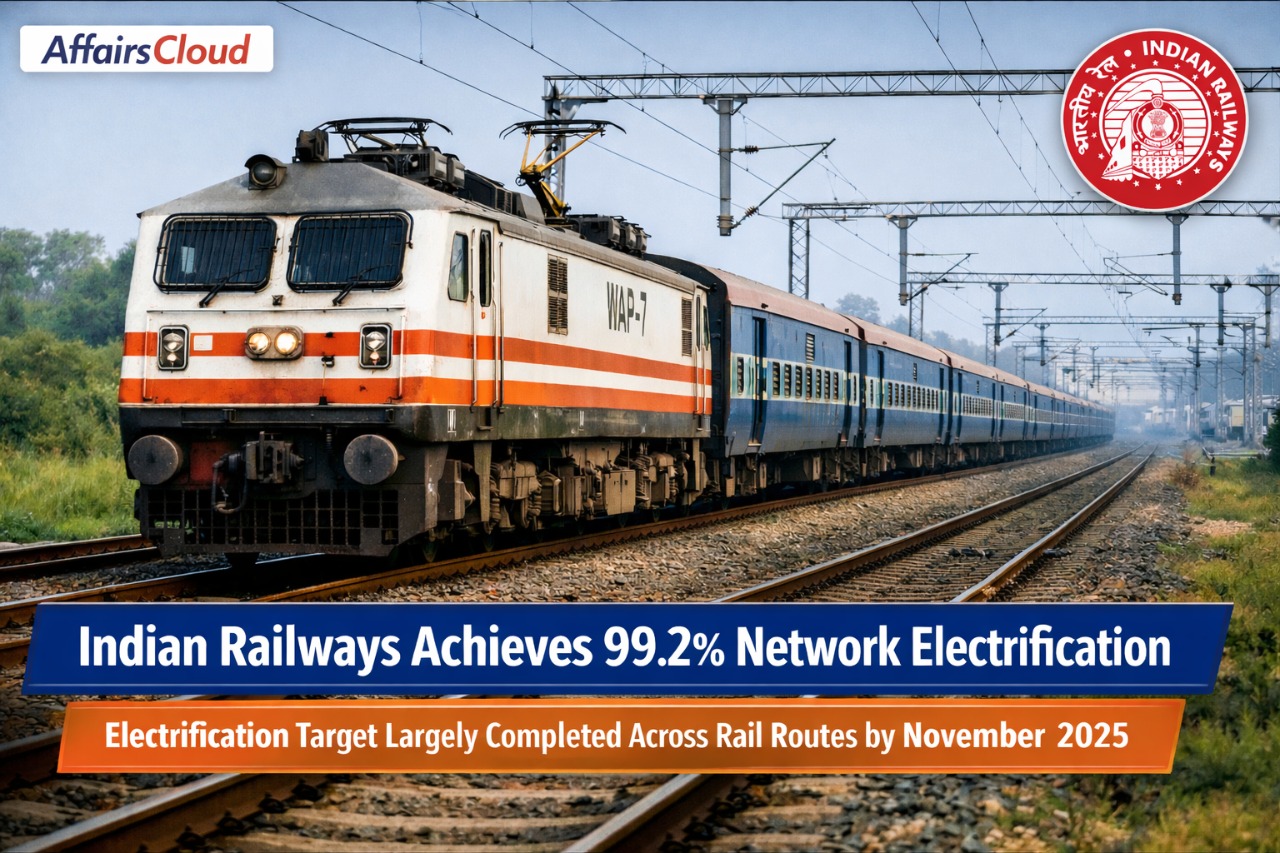
In January 2026, Indian Railways (IR) under the Ministry of Railways (MoR), electrified about 99.2% i.e. 69, 427 Route Kilometres (RKMs) of its broad-gauge network (70,001 RKMs)by November 2025, emerging as one of the world’s most extensively electrified rail systems. Out of the total area electrified, electrification of 46,900 RKMs was done between 2014 and 2025.
- This significant milestone achieved by IR is in alignment with the ambitious “Mission 100% Electrification” which aims to transform India’s rail system from diesel-dependent network into a fast, efficient and environmentally sustainable backbone of transport.
Exam Hints:
- What? About 99.2% of IR’s Network Electrified
- Achieved by: by November 2025
- India’s Total Broad-Gauge Network: 70,001 RKMs
- Total RKMs Electrified: 69,427 RKMs
- Achieved under: Mission 100% Electrification
- Electrification Pace: from 1.4 km per day (between 2004-14) to over 15 km per day (between 2019-2025).
- 100% Electrification Achieved in: 25 States and UTs
- Electrification Pending in: Only 5 states, including Rajasthan (93 RKMs); TN (117 RKMs), Karnataka (151 RKMs), Assam (197 RKMs), and Goa (16 RKMs).
- India Surpassed Major Countries: China (82%), France (60%), Russia (52%)and UK (39%)
- IR’s Solar power capacity: 898 MW (as of November 2025), up from 3.68 MW (2014)
- Utilisation of Solar Power Commissioned: 70% (629 MW)for traction purposes and 30% (269 MW) for non-traction purposes
About IR Electrification in India:
1st Electric Train: India’s 1st electric train powered by 1500 Volt Direct Current (DC) system, ran between Bombay Victoria Terminus and Kurla Harbour in 1925.
- By the time of India’s Independence, IR had covered just 388 RKMs, a modest but historic shift towards energy-efficient rail transport.
Pace of IR Electrification: Electrification expanded from just 1.4 km per day (between 2004-14) to an average of over 15 km per day (between 2019-2025).
- Also, the share of electrified track increased significantly from just 24% (in 2000) to 40% in 2017, and surpassed 96% by December 31, 2024.
State-wise Electrification: At present, 25 States and Union Territories, have been electrified with no remaining routes pending.
- Only 5 states namely: Rajasthan, Tamil Nadu (TN), Karnataka, Assam, and Goa, have residual sections under electrification. Together, these states account for just 0.8% (574 RKMs)of the total network .
- RKMs remaining in these 5 states are: Rajasthan (93 RKMs); TN (117 RKMs), Karnataka (151 RKMs), Assam (197 RKMs), and Goa (16 RKMs).
Global Position of IR: With 99.2% of its network electrified, IR now ranks among the world’s leading rail networks, surpassing major countries like: China, France, the United Kingdom (UK) and Russia.
- According to the International Union of Railways (UIC) report, June 2025, Switzerland leads with 100% electrified railways, followed by China (82%), Spain (67%),Japan (64%), France (60%), Russia (52%)and the UK (39%).
Solar Power Drives IR Electrification: The solar power capacity of IR surged nearly 244 times i.e. from just 3.68 Mega-Watt(MW) (in 2014) to 898 MW (as of November 2025).
- Out of this total solar power capacity commissioned, nearly 70% (629 MW) supports traction power for electric trains, which reduces dependence on conventional grid electricity, while remaining 30% (269 MW) powers station lighting, service buildings, workshops, and railway quarters.
- Currently, this solar power is installed at 2,626 railway stations, reflecting widespread adoption of clean energy solutions.
Adoption of Modern Technologies: Adoption of advanced technologies has accelerated electrification of railways projects like:
- The adoption of cylindrical foundations has replaced the conventional Overhead Electrification (OHE) that requires intensive manual excavation and slow project progress. In contrast to OHE, the new technology streamlines the process by reducing labour effort and significantly saving time.
- Automatic Wiring Train: This advanced system enables simultaneous installation of catenary and contact wire with precision tension control, speeding up the wiring process and ensuring timely completion of electrification works.
About Ministry of Railways (MoR):
Union Minister- Ashwini Vaishnaw (Rajya Sabha- Odisha)
Minister of State (MoS)- V. Somanna (Constituency- Tumkur, Karnataka), and Ravneet Singh Bittu (Rajya Sabha- Rajastha)