

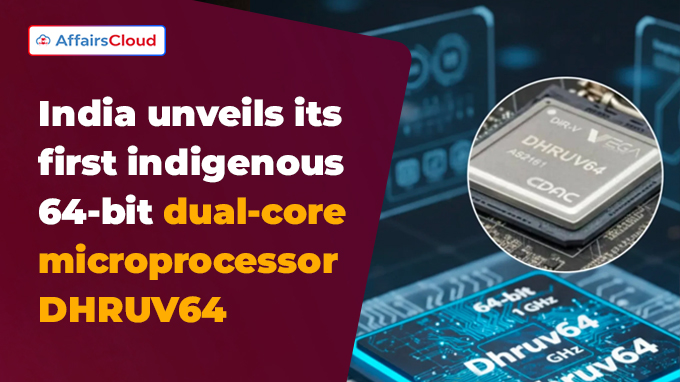
In December 2025, the Government of India (GoI) unveiled ‘DHRUV64’, India’s 1st indigenous built 1.0 Giga Hertz (GHz), 64-bit dual-core microprocessor, marking a significant milestone in strengthening India’s self-reliant microprocessor ecosystem.
Exam Hints:
- What? Launch of India’s 1st Indigenous 64-bit Dual-core Microprocessor
- Name: DHRUV64
- Developing Agency: C-DAC
- Key Specifications: 1.0 GHz, 64-bit dual-core microprocessor
- DIR-V Fabrication: 3rd processor under DIR-V programme
- Previous Fabricated Processors: THEJAS32 (Malaysia), THEJAS64 (SCL, Mohali)
- Other indigenous microprocessors: SHAKTI (2018), AJIT (2018), VIKRAM (2025), and THEJAS64 (2025).
- Next-Gen Variants: Dhanush and Dhanush+
About DHRUV64:
Developed by: This newly launched semiconductor chip was developed by the Centre for Development of Advanced Computing (C-DAC), Research and Development (R&D) organisation under the Ministry of Electronics and Information Technology (MeitY), under the Microprocessor Development Programme (MDP).
Key Features: DHRUV64 has been developed with modern architectural features that offer higher efficiency, improved multitasking capability and enhanced reliability.
- The DHRUV64 processor is designed for seamless integration with diverse hardware and, with modern fabrication technologies, is suitable for Fifth Generation(5G), automotive, consumer electronics, industrial automation, and Internet of Things (IoT) applications.
DIR-V Programme: The launch of DHRUV64 is part of the GoI’s Digital India RISC-V(Reduced Instruction Set Computer) (DIR-V) programme which aims to create a complete portfolio of RISC-V-based microprocessors in India.
- RISC-V is an open instruction set architecture that eliminates licensing costs and enables wider adoption through shared innovation across academia, startups, and industry.
Processor Lineage: DHRUV64 is the 3rd processor to be fabricated under DIR-V, following the THEJAS32, 1st chip fabricated at Silterra facility in Malaysia; and THEJAS64, manufactured locally at Semiconductor Lab (SCL) in Mohali, Punjab.
- Currently, India has 20% of global microprocessor production, reflecting the significance of indigenous development for long-term security.
Other Indigenous Microprocessors:
SHAKTI (2018): It was developed by Indian Institute of Technology-Madras (IIT-M), Chennai, Tamil Nadu(TN). It is specifically designed for strategic, space, and defence applications;
AJIT(2018): It was developed by IIT-Bombay (IIT-B),Mumbai(Maharashtra), is a microprocessor designed for industrial and robotics applications;
VIKRAM (2025): It was developed by Indian Space Research Organisation (ISRO) in partnership with SCL, is designed for space applications like: navigation, guidance, and mission operations;
THEJAS64 (2025): It was developed by C-DAC for industrial automation.
Next-Gen Variants: After the successful launch of DHRUV64, C-DAC is currently working on the development of Dhanush and Dhanush+, System on a Chip (SoC) variants which are under development.
Key Initiatives to Support Indigenous Chip Design:
Indian Semiconductor Mission (ISM): It was launched in December 2021, aims to provide structured support and attract semiconductor investments into the country.
- So far, the MeitY had approved 10 projects across 6 states under ISM, with a total investment commitment of Rs 1.60 lakh crore.
DIR-V Programme: It was launched in April 2022, focuses on the development of advanced RISC-V processors in India.
Chips to Startup (C2S) Programme: It is a capacity-building initiative, launched in 2022. The programme is implemented across 113 institutions, including 100 academic and R&D organisations, and 13 startups.
- The GoI had approved the programme with a total budget outlay of Rs 250 crore for a period of 5 years.
Design Linked Incentive (DLI) Scheme: Launched in 2021, the scheme offers financial assistance and design infrastructure support across various stages of development and deployment of semiconductor design for Integrated Chips (ICs), SoCs, and semi-conductor linked design for a period of 5 years.
INUP-i2i: The Indian Nanoelectronics Users Programme-idea to innovation(INUP-i2i) programme enables the researchers, students, and startups to access national nanofabrication facilities at leading institutions.
- So far, 49 familiarization workshops, 42 Hands-on-training workshops, 36 industrial trainings, and 10 hackathons have been conducted.
About Centre for Development of Advanced Computing (C-DAC):
Director-General (DG)- Magesh Ethirajan
Headquarters- Pune, Maharashtra
Established- 1988