

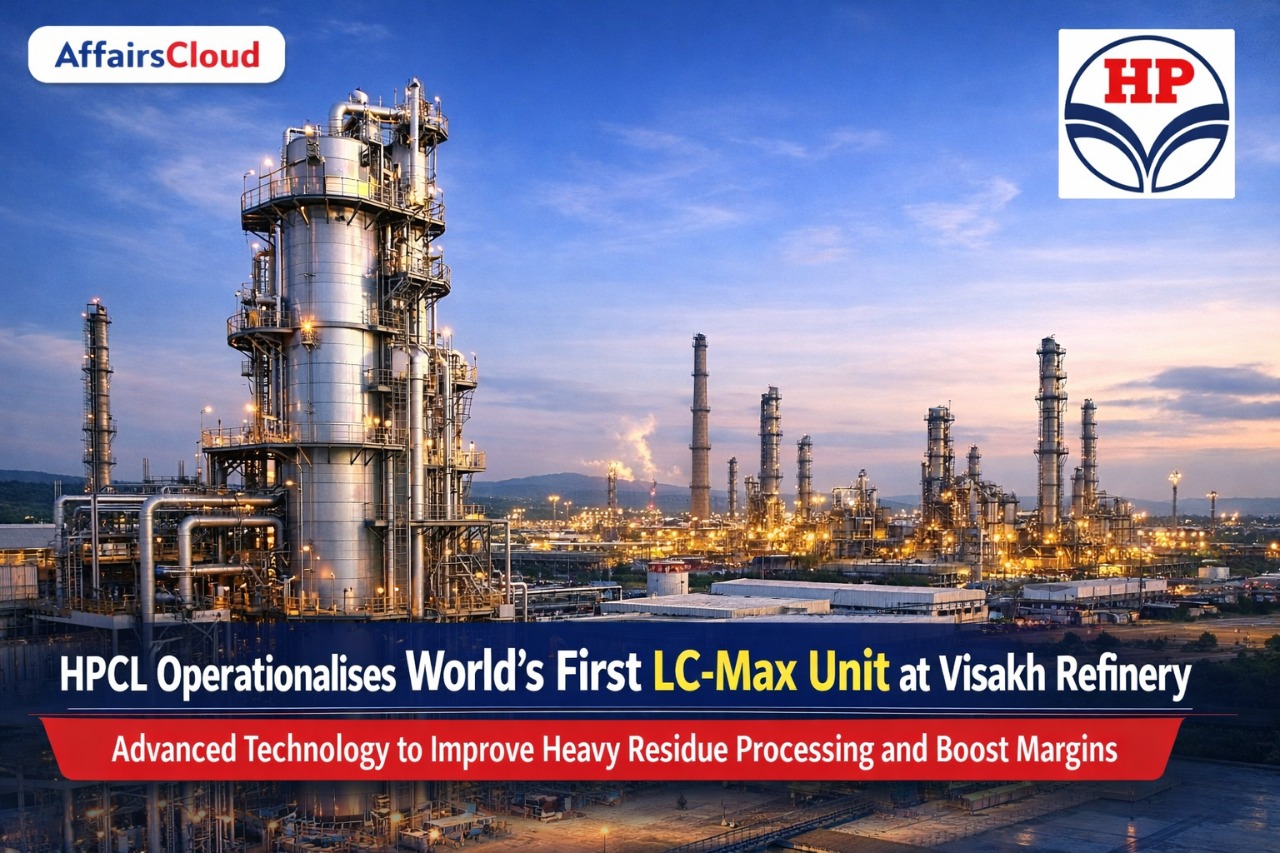
On January 5, 2026, Hindustan Petroleum Corporation Limited (HPCL), under the Ministry of Petroleum and Natural Gas (MoPNG), successfully commissioned the world’s first and largest Liquid Conversion–Maximum (LC-Max) Residue Upgradation Facility (RUF) at its Refinery in Visakhapatnam (Vizag), Andhra Pradesh (AP).
- HPCL also introduced a digital optimization system for the LC-Max unit to improve operational stability.
Exam Hints:
- What? World’s First LC-Max Unit commissioned
- Who? HPCL
- Where? Visakhapatnam (AP)
- Project: Visakh Refinery Modernisation Project (VRMP)
- Significance: India’s first residue hydrocracking unit
- Capacity: 3.55 MT
- RUF: 3 massive reactors, each weighing 2,200 tonnes
- Investment: Rs.31,407 crore
About World’s First LC-Max Unit :
Framework: The RUF was owned and developed by HPCL as part of its Visakh Refinery Modernization Project (VRMP).
- With an investment of Rs.31,407 crore, HPCL’s Visakh Refinery has expanded its crude processing capacity from 8.33 million tonnes per annum (MMTPA) to 15 MMTPA.
Partner Institutions: Engineers India Limited (EIL) served as the Project Management Consultant (PMC), and Larsen & Toubro (L&T) acted as the Engineering, Procurement, and Construction (EPC) contractor.
- Chevron Lummus Global (CLG) licensed the core LC-Max technology.
Capacity: The facility includes, India’s first residue hydrocracking unit, has a capacity of 3.55 million tonnes per annum (MTPA) and can convert about 93% of low-value bottom-of-the-barrel oils into higher-value products such as diesel, jet fuel, gasoil, and other middle distillates.
- It comprises three massive reactors, each weighing about 2,200 tonnes (T), making it among the heaviest refinery modules globally.
Distillate Output: The distillate yields such as diesel and kerosene are expected to increase by up to approximately 10% compared to before the upgrade.
GRM: The facility improves the Gross Refining Margin (GRM) by enabling more conversion of heavy residues into marketable fuels than low-value residues.
Nelson Complexity Index: With the commissioning of the LC-Max unit, the Nelson Complexity Index of the refinery has increased to around 11.6, making it India’s most sophisticated and complex refineries, capable of handling advanced deep-conversion processes.
About Digital Optimization System:
Performance Enhancement: The system at the Vizag refinery is designed to enhance the performance of the LC-Max unit by combining advanced digital tools with refinery operations.
Data Monitoring: It uses real-time data monitoring to track key process parameters, predictive analytics to anticipate operational issues, and Artificial Intelligence (AI)-driven optimization to fine-tune operating conditions.
Operational Stability: The capabilities help improve operational stability, product yields, energy efficiency, and on-stream performance, while reducing downtime and variability.
About LC-Max Technology:
Technology: It is a next-generation residue hydrocracking technology that upgrades heavy refinery residues, low-value products into high-value fuels. It uses advanced catalysts, hydrogen management, and digital optimization.
Key Features: It converts vacuum residues and other heavy fractions into lighter products, maximises diesel and jet fuel output, efficiently processes heavy and sour crudes, and employs robust hydrocracking catalysts with high-pressure reactors for optimal conversion.
About Hindustan Petroleum Corporation Limited (HPCL):
Chairman & Managing Director (CMD) – Vikas Kaushal
Headquarters – Mumbai, Maharashtra
Established – 1974