

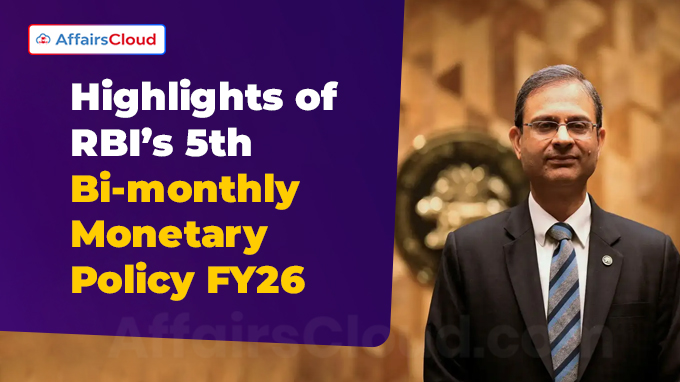
The Reserve Bank of India (RBI) conducted the 58 th and 5th Bi-monthly Monetary Policy Committee (MPC) meeting of Financial Year 2025-26 (FY26) from December 3 to 5, 2025 under the chairmanship of Sanjay Malhotra, Governor, RBI.
- The meeting was attended by the MPC members Dr. Nagesh Kumar, Saugata Bhattacharya, Prof. Ram Singh, Dr. Poonam Gupta and Indranil Bhattacharyya.
Exam Hints:
- What? 5th Bi-MPC of FY26
- Policy Rate: Repo – 5.25%, Reverse repo – 3.35%, SDF – 5.00%, MSF – 5.50%
- GDP: 7.3% for FY26
- Inflation: 2.0% for FY26
- CAD: 1.3% Q2:FY26
- Forex Reserves: USD 686.2 bn
- OMO: USD 1 tn, 3 year USD 5 bn swap
- Campaign: 2 month from 1st Jan to clear complaints
RBI reduces Repo Rates to 5.25%, Maintains ‘Neutral’ Stance:
Rate Cut: The MPC voted unanimously to reduce the policy repo rate under the Liquidity Adjustment Facility (LAF) to 5.25%.
- Consequently, the Standing Deposit Facility (SDF) rate shall stand adjusted to 5.00% and the Marginal Standing Facility (MSF) rate and the Bank Rate to 5.50%.
- The MPC also decided to continue with the neutral stance, indicating rates may go up or reduce further.
Reason: RBI reduced the repo rate because inflation fell sharply to multi-year lows, while growth showed early signs of softening, creating space to support economic activity through a rate cut.
RBI Policy Rates:
| Category | Rate |
|---|---|
| Repo Rate | 5.25% |
| Reverse Repo Rate | 3.35% |
| Standing Deposit Facility (SDF) | 5.00% |
| Marginal Standing Facility (MSF) | 5.50% |
| Cash Reserve Ratio(CRR) | 3.00% |
| Statutory Liquidity Ratio(SLR) | 18.00% |
| Bank Rate | 5.50% |
RBI lifts real GDP growth forecast to 7.3%:
Gross Domestic Product (GDP) Forecast: The committee has projected the real GDP growth for FY26 at 7.3%.
- The GDP registered a high growth of 8.2% in Quarter 2 (Q2:July – September 2025).
- The projection for FY26 for Q3 (October – December 2025) at 7.0%; Q4 (January – March 2026) at 6.5%.
- The real GDP growth for Q1:2026-27 (April-June 2026) is projected at 6.6% and Q2 at 6.8%.
RBI revised FY26 inflation outlook to 2%:
Inflation Projection: The medium-term target for Consumer Price Index (CPI) inflation is 4% within a band of +/- 2%.
- The CPI inflation for FY26 is now projected at 2.0% with Q3 at 0.6%; and Q4 at 2.9%.
- CPI inflation for Q1:2026-27 and Q2 are projected at 3.9% and 4.0%, respectively.
Current Account Deficit (CAD) unlikely to hit 2%:
CAD: India’s CAD moderated to 1.3% in Q2 FY26 on account of robust services exports and strong remittances.
- In October 2025, merchandise exports contracted year-on-year (Y-o-Y), whereas merchandise imports continued to increase for the second consecutive month, resulting in a widening of the trade deficit.
RBI announces Rs 1 trillion (tn) OMO and 3 year dollar-rupee buy-sell swap:
Open Market Operations (OMO): The RBI decided to conduct OMO purchases of government securities of Rs 1,00,000 crore (cr) and a 3-year USD/INR Buy Sell swap of USD 5 billion (bn) to inject durable liquidity into the system.
- These measures will ensure adequate durable liquidity in the system and further facilitate monetary transmission.
India’s forex reserves at USD 686 bn:
Reserves: As on November 28, 2025, India’s foreign exchange reserves stood at USD 686.2 bn, providing a robust import cover of more than 11 months.
Launches two-month campaign:
Campaign: A two-month campaign is proposed from 1st January 2026 to resolve all complaints pending with the RBI Ombudsman for over a month.
Important Definitions:
Repo Rate: It is the interest rate at which the RBI lends money to commercial banks for short-term needs, against government securities.
Reverse Repo rate: It is the interest rate at which the RBI borrows money from commercial banks, usually for short durations.
Open Market Operations (OMO): It is defined as RBI’s purchase and sale of government securities (G-secs) in the open market to manage the money supply and overall liquidity in the banking system, aiming to control inflation and support economic stability.