

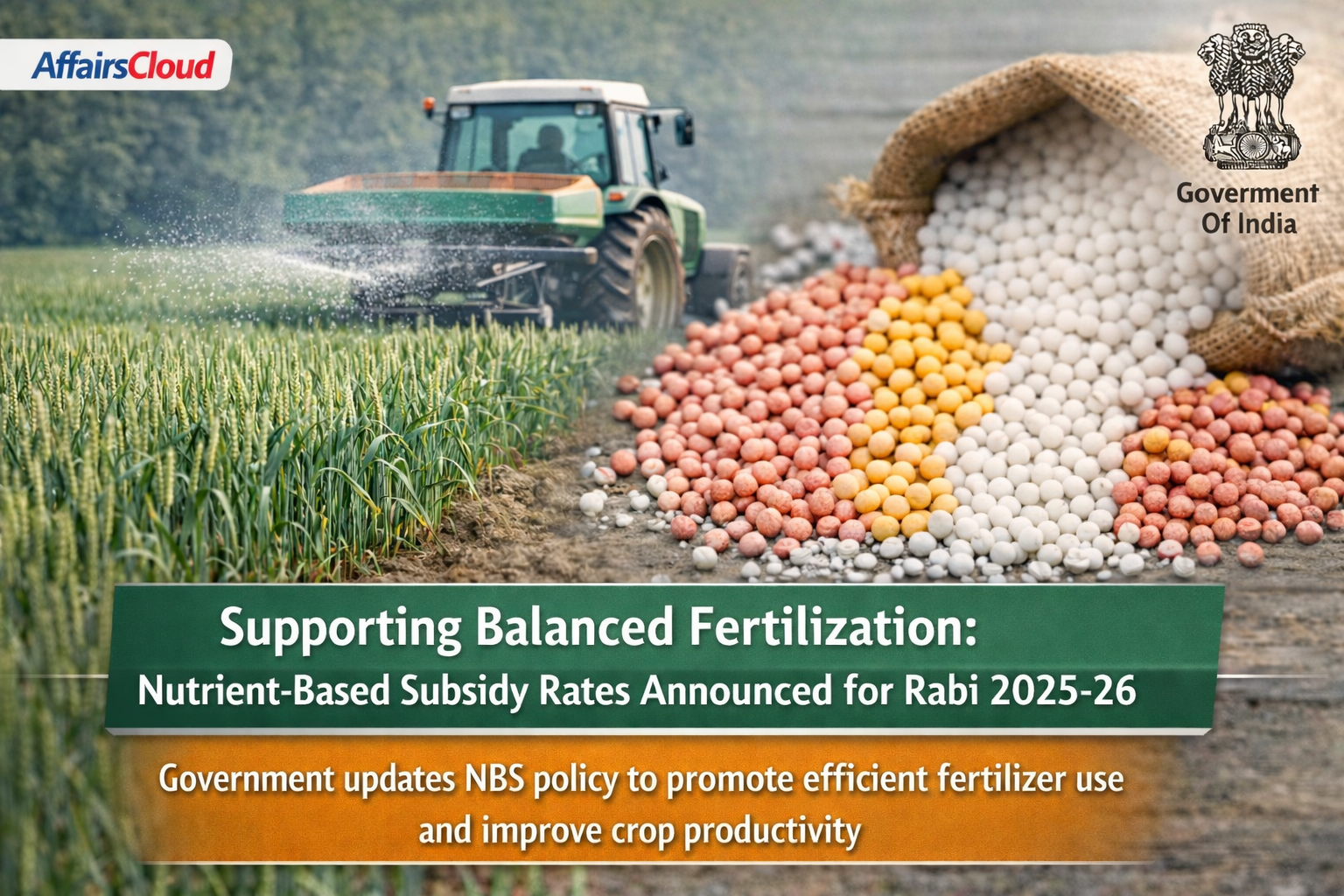
In January 2025, the Government of India (GoI) approved the Nutrient-Based Subsidy (NBS) rates for the Rabi 2025–26 season, effective from October 1, 2025 to March 31, 2026, for Phosphatic and Potassic (P&K) fertilizers, including Di-Ammonium Phosphate (DAP) and NPKS(Nitrogen, Phosphorus, Potassium, and Sulphur) grades.
Exam Hints:
- What? Approval of NBS rates for Rabi 2025–26
- Validity: 1 October 2025 – 31 March 2026
- Approved by: Government of India (GoI)
- Ministry: Ministry of Chemicals and Fertilizers (MoC&F)
- Implemented by: Department of Fertilizers (DoF)
- Coverage: P&K fertilizers including DAP and NPKS grades
- Budget Requirement: Rs 37,952.29 crore for Rabi 2025-26
- Fertilizers Covered: 28
- NBS Launch: On 1 April 2010
- Objective: Promote balanced fertilization and ensure affordable fertilizers
About Nutrient-Based Subsidy (NBS) Scheme:
Background: NBS Scheme, launched on 1 April 2010 and implemented by the Department of Fertilizers (DoFz) under the Ministry of Chemicals and Fertilizers (MoC&F), promotes balanced fertilization and discourages excessive use of nitrogen-based fertilizers.
Framework: Under this Scheme, the GoI extends a fixed subsidy, revised annually or biannually, on P&K fertilizers, including DAP. The subsidy is determined on the basis of the nutrient content of each fertilizer grade, ensuring support is aligned with its composition.
Expanded Access: The GoI is providing farmers with 28 types of P&K fertilizers, up from 25 grades originally covered, at subsidized rates through authorized manufacturers and importers, under its farmer-centric approach.
- From Kharif 2024, three new grades were added NPK (11:30:14) fortified with Magnesium, Zinc, Boron, and Sulphur; Urea-SSP (5:15:0:10); and SSP (0:16:0:11) fortified with Magnesium, Zinc, and Boron.
- Ammonium Sulphate (NH4)2SO4, has also been included under the NBS scheme for the Rabi 2025-26 season.
About Nutrient-Based Subsidy (NBS) Scheme – Rabi 2025–26:
Features: The policy has a fixed subsidy, a decontrolled P&K sector with company-set Maximum Retail Price (MRP) under GoI oversight, and subsidies passed directly to farmers.
Compliance: Fertilizer companies must submit audited cost data, adhere to profit margin limits (Importers 8%, Manufacturers 10%, Integrated 12%), display MRP and subsidy on bags, and face penalties for overcharging under the Essential Commodities Act(ECA), 1955.
Budget: The government has estimated a tentative budgetary requirement of Rs. 37,952.29 crore for the Rabi 2025–26 season, which is approximately Rs.736 crore higher than the allocation for the Kharif 2025 season.
NBS Rates: For Rabi 2025–26, the NBS rates are Rs. 43.02 per kg (kilogram) for Nitrogen (N), Rs. 47.96 per kg for Phosphorus (P), Rs. 2.38 per kg for Potassium (K), and Rs. 2.87 per kg for Sulphur (S).
DAP Subsidy: GoI has raised the DAP subsidy to Rs 29,805 per metric tonne (MT) from Rs 21,911 in Rabi 2024-25 to protect farmers from international price volatility.
Fertilizer Subsidies: Subsidized fertilizers include DAP (18-46-0-0) at Rs 29,805/MT, Muriate of Potash (MOP 0-0-60-0) at Rs 1,428/MT, and Single Super Phosphate (SSP 0-16-0-11) at Rs 7,408/MT.
Production and Productivity:
- Fertilizer Production: Domestic production of P&K fertilizers (DAP and NPKS) increased by over 50%, rising from 112.19 Lakh Metric Tonnes (LMT) in 2014 to 168.55 LMT by 30th December 2025.
- Foodgrain Yield: Foodgrain productivity grew from 1,930 kg per hectare in 2010–11 to 2,578 kg per hectare in 2024–25.
Fortification Incentives: Fertilizers fortified or coated with Boron (B) or Zinc (Zn) are eligible for additional incentives of Rs 300 and Rs 500 per MT respectively, as per the Fertilizer Control Order.
Operational Oversight: The GoI ensures transparent and fair implementation of the NBS Scheme through regulated Maximum Retail Price (MRP), profit margin controls, mandatory display of subsidy details, and strict compliance by fertilizer companies.
- Production, movement, and availability of fertilizers are digitally monitored through the Integrated Fertilizer Management System (iFMS), supported by monthly supply planning and regular coordination with States to ensure timely delivery to farmers.
Achievements: P&K fertilizer production rose over 50% from 112.19 LMT in 2014 to 168.55 LMT by 2025, while foodgrain productivity increased from 1,930 kg/ha (kilograms per hectare) in 2010–11 to 2,578 kg/ha in 2024–25.
About Ministry of Chemicals and Fertilizers (MoC&F):
Union Minister– Jagat Prakash Nadda (Rajya Sabha – Gujarat)
Minister of State (MoS)– Anupriya Patel (Constituency – Mirzapur, Uttar Pradesh, UP)