

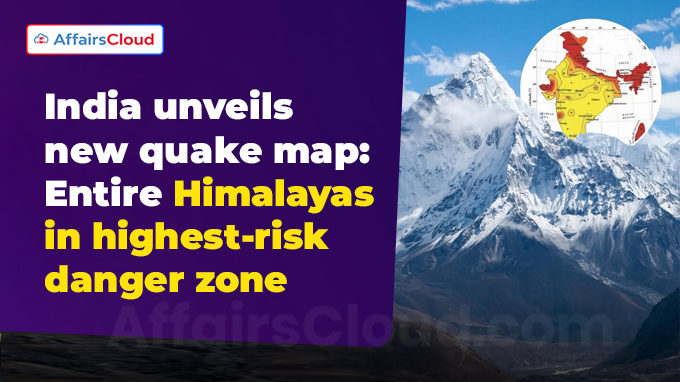
In November 2025, the Bureau of Indian Standards (BIS), statutory body under the Ministry of Consumer Affairs, Food and Public Distribution (MoCAF&PD), unveiled a revised seismic zonation map under the updated Earthquake Design Code 2025(BIS, 2025), incorporating data on active faults, maximum probable events, attenuation patterns, tectonics, and lithology.
Exam Hints:
- What? Release of New Seismic Zonation Map
- Released by: BIS, MoCAF&PD
- Released under: Revised Earthquake Design Code (BIS, 2025)
- New Zone: Zone-VI (highest seismic-hazard)
- Region Placed under Zone-VI: Entire Himalayan Arc
- Area under Seismic Zone: 61% of India’s total land mass (Moderate to High hazard zones)
- Population Exposure: 75%
About New Methodologies:
Updated Zonation: Previously divided into Zones II–V, India’s seismic map now includes a newly introduced Zone VI, the highest-risk category.
PSHA: As per the BIS, the new quake map had been created using globally accepted Probabilistic Seismic Hazard Assessment (PSHA) methods that include detailed data on active faults, the maximum potential magnitude on each fault, the tectonic regime of each region, among others.
PEMA: The new seismic map has introduced a new concept known as the ‘Exposure Window’ which takes into account population density, infrastructure, and socio-economic vulnerability through the Probabilistic Exposure and Multi-Hazard (PEMA) methodology.
About New Seismic Map:
Himalayas in Highest-Risk Zone VI: For the first time, the new seismic map classifies the entire Himalayan arc, including the Union Territories(UTs) of Jammu & Kashmir (J&K) and Ladakh, and the states of Himachal Pradesh (HP), Uttarakhand, Sikkim, and Arunachal Pradesh (AR), under the newly introduced Zone VI, the highest seismic‑hazard category.
- Previously divided between Zones IV and V, the Himalayan belt is now uniformly classified as Zone VI, reflecting consistent tectonic stress across the arc.
Expansion : The map further revealed that 61% of India’s landmass now lies in moderate to high hazard zones, marking one of the major shifts in seismic hazard assessment in decades.
- Earlier, about 59% of the country’s landmass was classified as earthquake-prone, of which nearly 11% lies in Zone-V, 18% (in Zone IV), 30% (in Zone-III), and the remaining area in Zone-II.
Population Vulnerable: The newly released map showed that 75% of the Indian population lives in seismically active regions.
Safety Requirements for Buildings: Also, the revised seismic map introduced ‘sweeping safety requirements’ for both structural and non-structural elements.
- As per BIS new guidelines, the elements of non-structural buildings like parapets, ceilings, tanks, facades, and fixtures, are required to be securely anchored if they account for over 1% of a building’s weight.
Critical Infrastructure: Hospitals, Schools, Bridges, Pipelines, and Major Public Buildings have been instructed to remain functional after major earthquakes, ensuring emergency response and continuity of essential services.
Auto-upgradation of Boundary Towns: As per the new map, towns located along any boundary separating two categories will now be automatically upgraded to ‘higher-risk zone’ to ensure that planners and engineers adopted stringent standards for buildings, bridges, and urban projects in vulnerable areas.
About Bureau of Indian Standards (BIS):
Director General(DG) – Sanjay Garg
Headquarters- New Delhi, Delhi
Established- 1987