
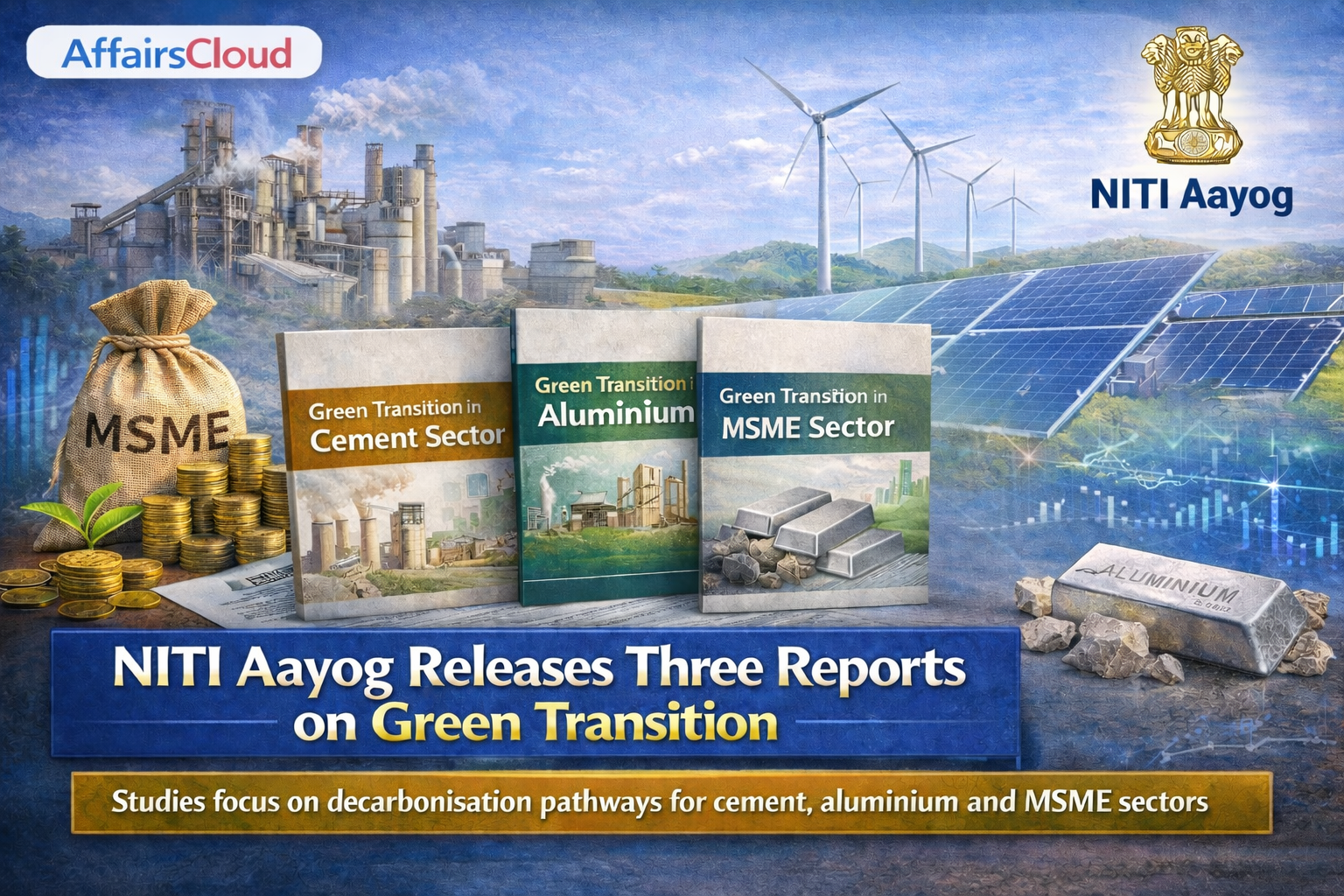

On January 21, 2026, the National Institution for Transforming India (NITI) Aayog, policy think tank of the Government of India (GoI), released three reports, which are roadmaps for the green transition and decarbonization in sectors such as cement, aluminium, and Micro, Small and Medium Enterprises (MSMEs).
- The reports outline strategies to reduce emissions and adopt green technologies, in alignment with GoI’s goal of Net Zero by 2070.
Exam Hints:
- What? Three green transition/decarbonisation roadmaps released
- Sectors Covered: Cement, Aluminium, MSMEs
- Released by: NITI Aayog
- Cement sector: Use of RDF, supplementary cementitious materials & clinker substitutes
- Aluminium sector: short term (up to 2030), medium term (2030-2040), long term (beyond 2040)
- MSMEs sector: energy-efficient equipment deployment, adoption of alternative fuels, green electricity integration
- Alignment: Net Zero by 2070 target of GoI
Key Highlights of Roadmaps on Decarbonization:
Background: The roadmaps were developed in consultation with ministries, industry stakeholders, research institutions and knowledge partners to provide practical pathways for sustainable industrial growth.
Industrial Decarbonisation: These initiatives aim to drive deep, sustained decarbonisation in one of India’s most emissions-intensive industries.
Cement Sector:
Overview: Cement production is expected to rise from 391 million tonnes (MT) in 2023 to about 2,100 MT by 2070. Its production contributed about 6% of India’s emissions in 2023. The report suggests reducing the carbon intensity of cement sector from 0.63 tonnes of carbon dioxide equivalent (tCO₂e) per tonne of cement to approximately 0.09-0.13 tCO₂e per tonne by 2070.
Recommendations: The report recommended the use of Refuse Derived Fuel (RDF) from municipal waste instead of coal in thermal processes, greater use of supplementary cementitious materials and clinker substitutes, and Carbon Capture, Utilization and Storage (CCUS) to capture process emissions.
- The solutions could reduce 80-85% of Greenhouse Gas (GHG) emissions in the cement sector by 2070.
Aluminium Sector:
Overview: Aluminium output is projected to grow from 4 MT in 2023 to 37 MT by 2070. The sector accounts for about 2.8% of India’s total GHG emissions (around 83 Metric tons of carbon dioxide equivalent(MTCO2e)) in 2023 and without interventions.
Key Recommendations: The aluminium roadmap outlines a three-stage strategy, including:
- In the short term up to 2030, the aluminium sector is advised to shift to Renewable Energy-Round the Clock (RE-RTC) supported by improved grid connectivity.
- In the medium term from 2030 to 2040, the aluminium sector is expected to adopt nuclear power as part of its energy mix.
- In the long term beyond 2040, CCUS may be integrated with captive-based generation if required.
Balancing Growth : This strategy ensures rapid capacity expansion while maintaining energy security and achieving emissions reduction goals.
MSME Sector:
Overview: MSMEs contribute about 30% to Gross Domestic Product (GDP), employ over 250 million people, and account for 46% of exports.
Key Recommendations: The roadmap for MSMEs recommends deployment of energy-efficient equipment, adoption of alternative fuels, and integration of green electricity to drive the green transition.
Approach: The report highlights a cluster-based implementation framework to enable scalable, cost-effective, and easily adoptable green solutions across diverse MSME segments.
About National Institution for Transforming India (NITI) Aayog:
Chief Executive Officer (CEO) – B.V.R Subrahmanyam
Headquarters – New Delhi, Delhi
Established – 2015