
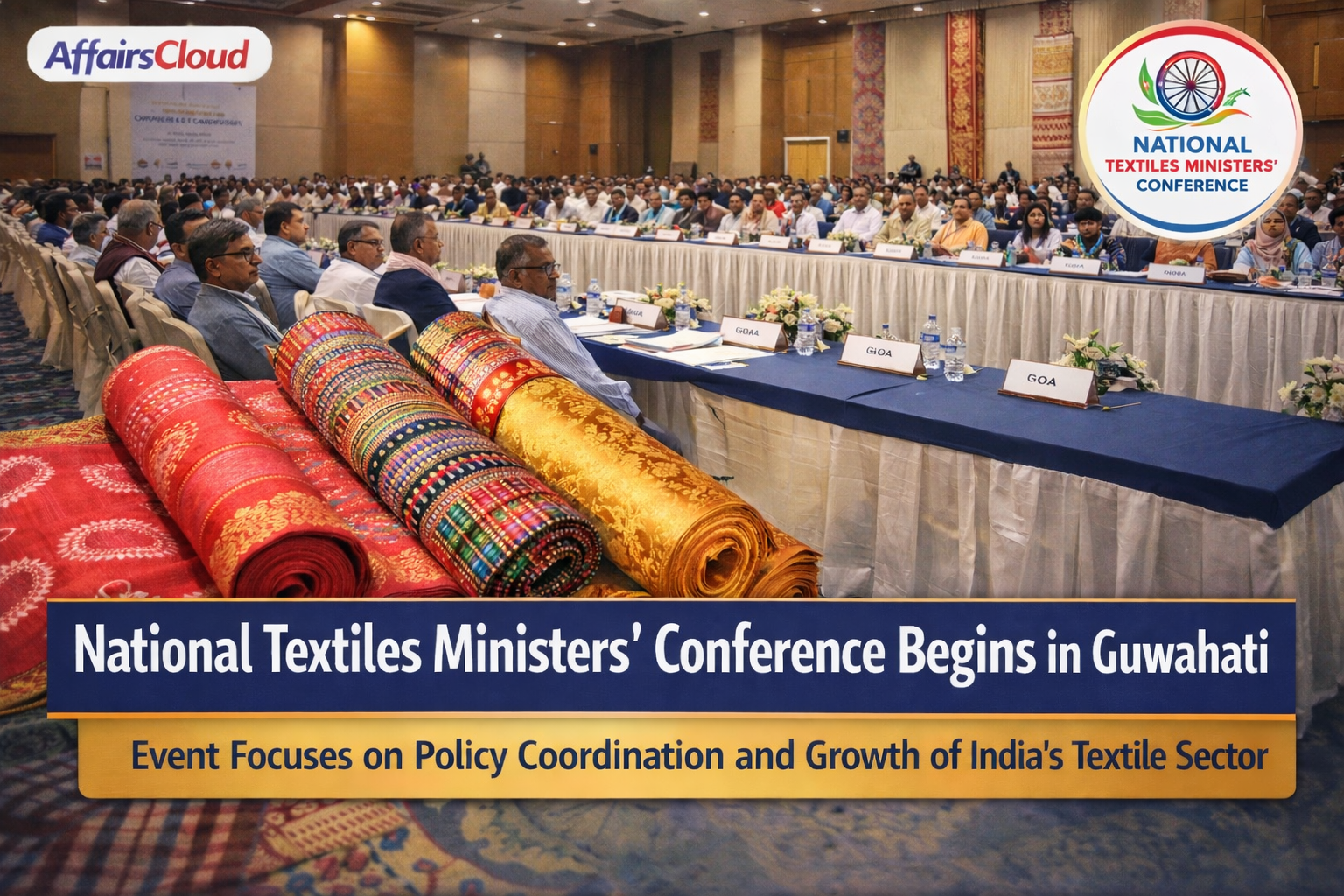

The National Textiles Ministers’ Conference 2026 was held from January 08 to 09, 2026 in Guwahati, Assam, under the theme “India’s Textiles: Weaving Growth, Heritage & Innovation”.
- The two-day national conference, organised by the Ministry of Textiles (MoT) in collaboration with the Government of Assam, brought Textile ministers and senior officials from states and Union Territories (UTs) across the nation.
Exam Hints:
- Event: National Textiles Ministers’ Conference 2026
- Held in: Guwahati, Assam
- Theme: “India’s Textiles: Weaving Growth, Heritage & Innovation”
- Organisers: Ministry of Textiles (MoT) & Government of Assam
- Target: USD 350 bn textile economy by 2030
- Key Outcomes:
- Launch: District-Led Textiles Transformation (DLTT) Plan
- Report Released: India’s Textile Atlas: State Compendium 2025
- MoU Signed:
- MoU-1:Textiles Committee and NEHHDC, MoDoNER
- Purpose: IPR protection of GI products from NE states
- MoU-2 : MoT and 15 States
- Signed under: Tex-RAMPS, CSS
About National Textile Ministers’ Conference 2026:
Key Dignitaries: The inaugural session of the conference was attended by Union Minister Giriraj Singh, MoT; Union Minister of State (MoS) Pabitra Margherita, MoT; Dr. Mohan Yadav, Chief Minister (CM) of Madhya Pradesh (MP); Dr. Himanta Biswa Sarma, CM of Assam, and other dignitaries.
Aligns with: The conference was in line with the Government of India(GoI’s) vision to position India as a global textile manufacturing hub by 2030.
- The special focus will be on promoting exports, employment generation, and inclusive growth, aligned with the guiding principle of ‘Vikas Bhi, Virasat Bhi (Development and Heritage)’.
Significance of Textiles Sector: The Government of India (GoI) has set the ambitious target of building a USD 350 billion textile economy by 2030.
- As per the Handloom Census 2019–20, the Northeastern region accounts for about 52% of India’s total handloom production.
Key Highlights:
Release of Report: During the event, a report titled “India’s Textile Atlas: State Compendium 2025” was officially released.
Special Conclave: On the sidelines of the conference, a special conclave on ‘Strengthening and Empowering the Textiles Sector of the North-Eastern Region of India’ was organised, to unlock the north-eastern region’s potential in silk handloom, handicrafts, and bamboo-based textiles, with special emphasis on Eri, Muga, and Mulberry silk, women-led enterprises, branding and market access.
Textiles Committee, NEHHDC Signed MoU on IPR:
Signatories: The Textiles Committee under MoT signed a Memorandum of Understanding (MoU) with the North Eastern Handloom and Handicraft Development Corporation (NEHHDC), a Public Enterprise under the Ministry of Development of North Eastern Region (MDoNER), during the North Eastern Region (NER) conclave held in Guwahati, Assam.
IPR Safeguard: This strategic partnership marks a major step towards Intellectual Property Rights (IPR) protection of unique products from the North Eastern states through GI registration and post-GI initiatives.
Key Details: For the initial phase, the initiative will facilitate GI registration of 33 unique products including 18 from Nagaland and 15 from Meghalaya, under the Geographical Indications of Goods (Registration and Protection) Act, 1999.
- Under the MoU, both entities will jointly work with the Centre and Northeastern States to promote textiles and allied sectors, with emphasis on GI registration, capacity building, branding, and market access.
Launch of DLTT Plan:
Overview: During the conference, MoT unveiled the District-Led Textiles Transformation (DLTT) Plan, a strategic initiative designed to accelerate inclusive and sustainable growth across India’s textile landscape.
Target: This newly launched initiative aims to transform 100 high-potential districts into Global Export Champions and elevate 100 Aspirational Districts into self-reliant hubs.
Methodology: All districts were analyzed by MoT, using a data-driven scoring methodology based on 3 main parameters: Export Performance, Micro, Small and Medium Enterprises (MSME) Ecosystem and Workforce Presence.
Two-Pronged Strategy: MoT has developed a two-pronged strategy where districts were categorized into: Champion Districts and Aspirational Districts.
- Champion Districts (Scale and Sophistication): The key focus of these districts is to remove advanced bottlenecks. Interventions like: elevating to Mega Common Facility Centres, integrating Industry 4.0, and facilitating direct Export Market Linkages.
- Aspirational Districts: These Districts will build the ecosystem from the ground up establishing foundation and formalization of workforce. This includes basic skilling and certification, setting up Raw Material Banks, and supporting enterprises through Self-Help Groups (SHGs) and Cooperatives, among others.
Prioritizes NorthEast and East Zones: This newly launched initiative stresses on Purvodaya convergence in east and northeast zones. These regions are prioritized for tribal belt development, better connectivity, and Geographical Indication (GI) tagging to showcase unique cultural handicrafts for premium international markets.
MoUs with 15 States under Tex-RAMPS:
Objective: On the inaugural day of the conference, MoT signed MoUs with 15 states, aimed to create a strong operational framework to bolster the data systems under the Textiles-focused Research, Assessment, Monitoring, Planning and Start-Up (Tex-RAMPS) scheme.
Tex-RAMPS: Tex-RAMPS, a Central Sector Scheme (CSS), with a total budget outlay of Rs 305 crore for the period from 2025-26 to 2030-31, is designed to enhance coverage, quality, timeliness, and credibility of textile-related statistical products and research.
- It aims to accelerate integrated planning for key sectors including, handlooms, handicrafts, apparel, technical textiles, among others, at both cluster and district levels.
- MoT provides an annual financial assistance of Rs 12 lakh to each State/UT. Also, an additional grant of Rs 1 lakh per year for each district, will be disbursed based on the development and execution of specific district action plans.
About Ministry of Textiles (MoT):
Union Minister- Giriraj Singh (Constituency- Begusarai, Bihar)
Union Minister of State (MoS)– Pabitra Margherita (Rajya Sabha- Assam)