
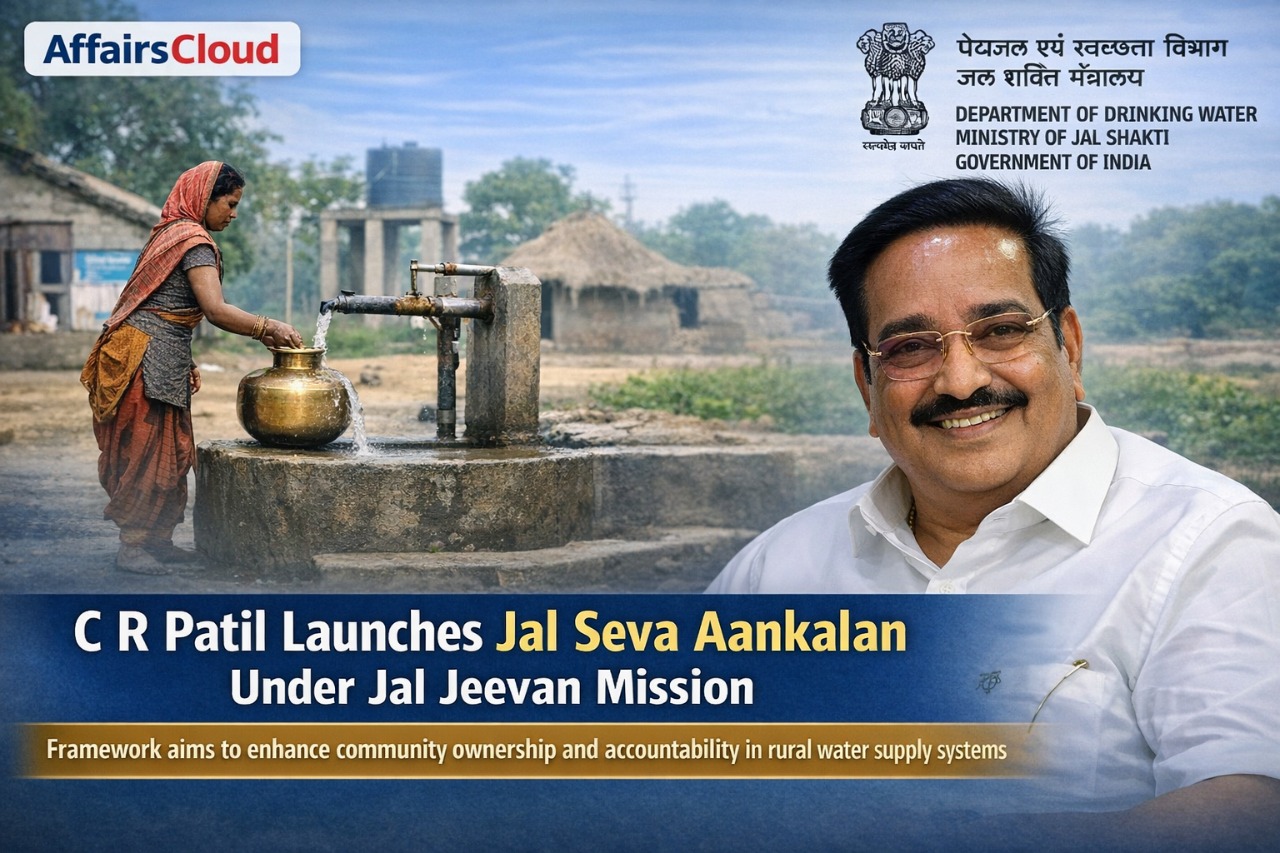

In December 2025, the Department of Drinking Water and Sanitation (DDWS), Ministry of Jal Shakti(MoJS) launched ‘Jal Seva Aankalan’, a Gram Panchayat (GP)-led digital drinking water service functionality assessment tool on the Jal Jeevan Mission (JJM) portal.
- The tool was virtually launched by Union Minister C R Patil, Ministry of Jal Shakti (MoJS) in the presence of Union Minister of State(MoS) V. Somanna,MoJS, Union MoS Raj Bhushan Choudhary,MoJS along with senior officials from the DDWS.
Exam Hints:
- What? Launch of Jal Seva Aankalan
- By Whom? Union Minister C.R. Patil, MoJS
- Focus: Community-owned self-assessment, sustained service delivery
- Timeline: 26 January 2026
- Key Roles: District – ZPs plan & coordinate; Block – Train Panchayat Secretaries
About Jal Seva Aankalan:
Overview: It is a community-owned self-assessment process that enables villages to collectively review their water service delivery systems, reducing reliance on infrequent and costly third-party surveys.
Focus : The initiative shifts the focus from infrastructure creation to sustained service delivery, placing GP and village institutions at the centre of monitoring drinking water supply in Har Ghar Jal(HCJ) villages.
Assessment Process: The process starts with structured discussions involving members of the Village Water & Sanitation Committee (VWSC), the Panchayat Secretary, system operators, and a diverse group of water users, including women and vulnerable groups.
- The outcomes are subsequently presented to the Gram Sabha for open discussion and formal endorsement.
JJM Dashboard: After the approval from the Gram Sabha, the assessment is uploaded to the JJM Panchayat Dashboard and made publicly available on platforms such as eGramSwaraj and the Meri Panchayat Application(app)
- A 30-day window is provided for citizen feedback before the report is finalised.
- The findings will also be available to the District Collectors/Chief Executive Officer (CEO) Zila Panchayats (ZPs) and State Level authorities to enable corrective action.
Parameters covered: The assessment covers key service parameters, including Regularity and adequacy of water supply, Drinking water quality, Operation and maintenance of systems, Source sustainability and Village-level institutional and management arrangements.
Role Framework: At the district level, ZPs are expected to play an active facilitative role, leading planning and coordination efforts.
- At the block level, Systematic training, particularly of Panchayat Secretaries, is essential to ensure accurate data entry and effective implementation.
Timeline: All HGJ Gram Panchayats are expected to complete the Jal Seva Aankalan by 26 January 2026.
Expected Outcomes: Jal Seva Aankalan is expected to achieve the following outcomes:
- Anchor drinking water service assessment in Gram Sabha deliberations
- Enable early identification of operational, quality and sustainability challenges
- Improve transparency through public disclosure of service performance
- Support evidence-based district and state-level planning
- Reinforce community stewardship of rural water supply systems
About Jal Jeevan Mission (JJM):
Launch: The JJM was launched on August 15, 2019, with the ambitious goal to supply 55 litres of water per person per day to every rural household through Functional Household Tap Connections (FHTC) by 2024.
Key Pillars: The 4 key pillars of the mission are Political Will, People’s Participation, Stakeholder Collaboration, and Optimal Resource Use.
Implementation: It is implemented by the DDWS under the MoJS, serving as the central nodal ministry for policy direction.
About Ministry of Jal Shakti (MoJS):
Union Minister– Chandrakant Raghunath (C R) Patil (Constituency-Navsari, Gujarat)
Ministers of State (MoS)– Veeranna Somanna ( Constituency- Tumakuru, Karnataka ); Raj Bhushan Choudhary (Constituency- Muzaffarpur, Bihar)