
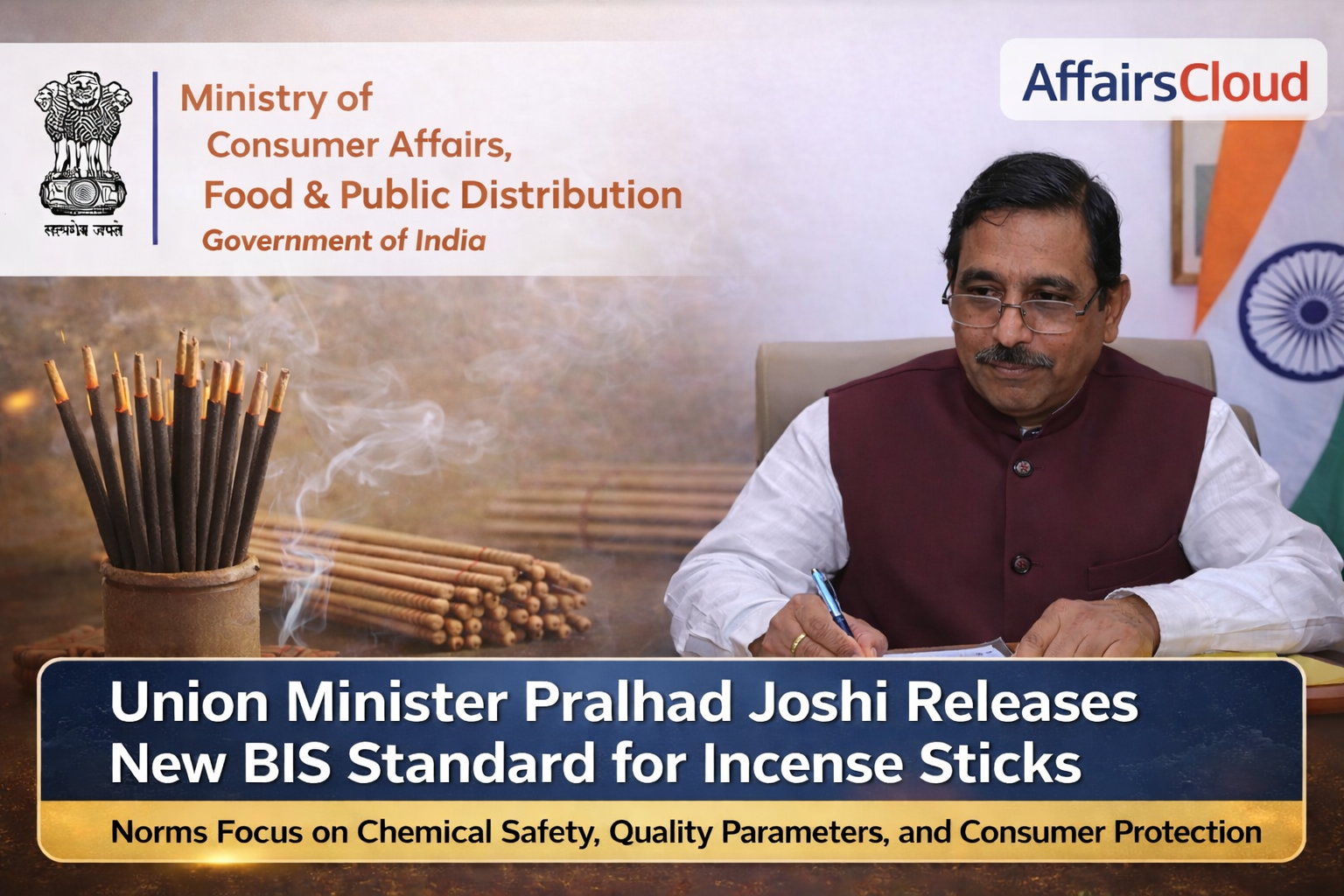

On December 24, 2025, Union Minister Pralhad Joshi, Ministry of Consumer Affairs, Food & Public Distribution (MoCAF&PD), unveiled a new Indian Standard (IS) 19412:2025 for Incense sticks (Agarbatti) Specification, developed by the Bureau of Indian Standards (BIS) under (MoCAF&PD), at Bharat Mandapam in New Delhi, Delhi.
- The launch, marking the first dedicated IS for incense sticks, was held to coincide with National Consumer Day 2025, observed on December 24, 2025.
Exam Hints:
- What? New IS 19412:2025 for Incense sticks (Agarbatti) unveiled
- Who? Union Minister Pralhad Joshi, MoCAF &PD
- When? National Consumer Day (December 24, 2025)
- Developer: Bureau of Indian Standards (BIS)
- Banned Chemicals: alethrin, permethrin, cypermethrin, deltamethrin and fipronil (Insecticidal), benzyl cyanide, ethyl acrylate and diphenylamine (synthetic fragrance)
- Classification: Machine-made, hand-made and traditional masala agarbattis
Key Features of IS 19412:2025:
Aim: The standard addresses health and indoor air concerns from harmful substances in incense sticks while aligning Indian manufacturing with global best practices.
Experts’ Input: The standard was developed by BIS with inputs from organizations, including:
- Council of Science and Industrial Research – Central Institute of Medicinal and Aromatic Plants (CSIR-CIMAP)
- CSIR-Indian Institute of Toxicology Research (CSIR-IITR)
- CSIR- Central Food Technological Research Institute (CSIR-CFTRI)
- Fragrance and Flavour Development Centre (FFDC)
- All India Agarbatti Manufacturers Association (AIAMA).
Prohibited Chemicals: Insecticidal chemicals such as alethrin(C₁₉H₂₅O₃), permethrin(C₂₁H₂₀Cl₂O₃), cypermethrin(C₂₂H₁₉Cl₂NO₃), deltamethrin(C₂₂H₁₉Br₂NO₃) and fipronil(C₁₂H₄Cl₂F₆NS) and Synthetic fragrance substances, including benzyl cyanide, ethyl acrylate and diphenylamine.
Classification: It classifies agarbattis into machine-made, hand-made and traditional masala agarbattis, sets rules for raw materials, burning quality, fragrance performance, and chemical safety, and ensures safer, better-quality and more consistent products.
Enhanced Consumer Safety: With this move, the products which comply with the standard can carry the BIS Standard mark, enabling consumers to choose safer and certified agarbattis.
- The standard mark encourages ethical and eco-friendly manufacturing, helps protect traditional artisans and livelihoods, and improves global acceptance and exports of Indian agarbattis.
India’s Agarbatti Industry: India is the largest producer and exporter of agarbattis in the world, with the value of Rs.8,000 crores per year and exports around Rs.1200 crore to over 150 countries.
About Bureau of Indian Standards(BIS):
Overview: BIS, established under the Bureau of Indian Standards Act, 2016, works under the MoCAF&PD and ensures quality, safety, and reliability of products and services in India.Each standard is given a unique number.
- It includes Mandatory standards and Voluntary standards.
Minimum Requirement: BIS standards are IS that set minimum requirements for quality, safety, performance, and environmental protection.
Expert committees: The standards are developed through expert committees, involving scientists, industry representatives, government bodies, and consumer organizations.
About Ministry of Consumer Affairs, Food and Public Distribution (MoCAF&PD):
Union Minister – Pralhad Joshi (Constituency – Dharwad, Karnataka)
Minister of State(MoS) – B.L. Verma (Rajya Sabha – Uttar Pradesh, UP), Nimuben Bambhaniya (Constituency – Bhavnagar, Gujarat)