
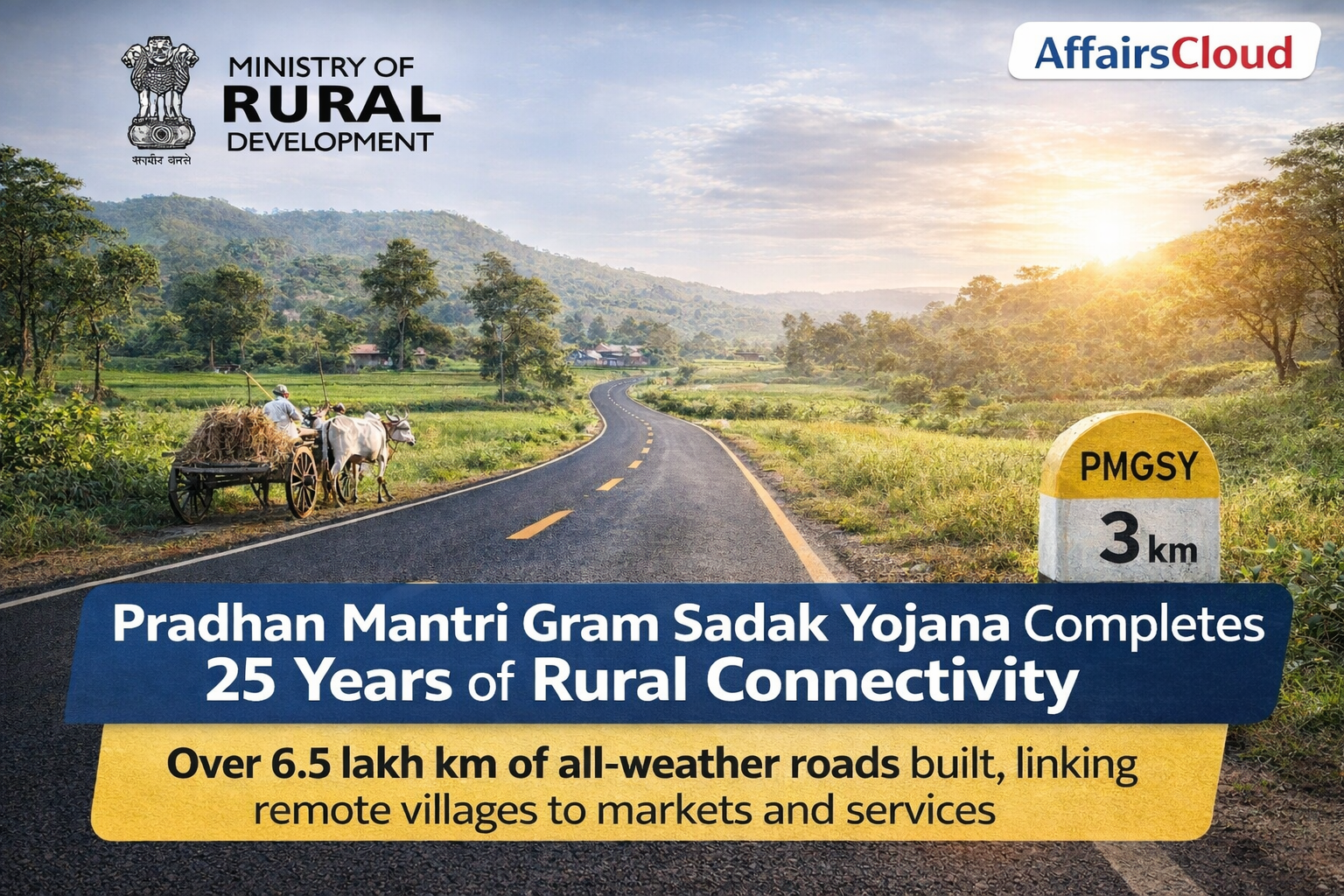

On 25 December 2025, the Pradhan Mantri Gram Sadak Yojana (PMGSY), launched on 25 December 2000 as one of India’s most transformative rural infrastructure programmes, celebrated its 25th anniversary.
- PMGSY has approved over 8,25,114 kilometre (km) of rural roads and completed around 787,520 km, achieving nearly 95% of the planned physical progress as of December 2025.
Exam Hints:
- What? 25th anniversary of Pradhan Mantri Gram Sadak Yojana (PMGSY)
- When? 25 December 2025
- Launch: 25 December 2000
- Nodal Agency: Ministry of Rural Development (MoRD)
- Funding Pattern: States 60:40; Special Category States 90:10; UTs without legislatures 100%
- Financial Outlay: FY26 – Rs 19,000 Cr
- Phase-wise Implementation:
- Phase-I: 2000; establishing foundation
- Phase-II: 2013; strengthening existing rural road
- Phase-III: 2019; Upgrade 1,25,000 km
- Phase-IV: 2024; 62,500 km roads; Rs 70,125 crore outlay;
- Digital Monitoring & Quality Tools:
- OMMAS: Physical and financial progress aligned with targets
- E-MARG: Monitoring of road
- GPS: GPS VTS installed for transparency and accountability
- 3–Tier: Field level quality check, SQM, NQM
About Pradhan Mantri Gram Sadak Yojana(PMGSY) :
Objective: The objective of PMGSY is to provide all-weather road connectivity to unconnected habitations in rural areas by way of a single all-weather road, to the eligible unconnected habitations of designated population size in the core network.
Nodal Agency: The programme is implemented by the Ministry of Rural Development (MoRD) through the Rural Roads Wing, in coordination with State Governments and Union Territories.
Funding Pattern: This is a Centrally Sponsored Scheme (CSS). The funding pattern of PMGSY is in the ratio of 60:40 in respect of all the States except Special Category States (8 North Eastern (NE) States: Jammu & Kashmir(J&K), Himachal Pradesh (HP), Uttarakhand and Union Territories (UTs) with Legislatures, for which the sharing pattern would be 90:10 and for UTs without legislatures, the centre will provide 100% funding.
Financial Allocation: For the Financial Year 2025-26 (FY26), an allocation of Rs 19,000 crore (Cr) has been made for the programme.
Phase wise implementation:
Phase-I: The phase-I was launched in 2000, establishing the foundation for universal rural access by linking villages with markets, educational institutions, and healthcare facilities.
- Road connectivity projects for a total of 1,63,339 rural habitations have been sanctioned nationwide under Phase I.
Phase-II: This phase launched in 2013 focused on strengthening and consolidating the existing rural road network. It prioritized the upgradation of economically important routes linking rural markets, growth centers, and service hubs.
- Road Connectivity Project for Left Wing Extremism Affected Areas (RCPLWEA): Launched in 2016, was a targeted intervention aimed at strengthening infrastructure development in regions affected by Left Wing Extremism (LWE).
- It covered 44 of the most severely affected LWE districts and adjoining areas across nine States: Andhra Pradesh (AP), Bihar, Chhattisgarh, Jharkhand, Madhya Pradesh (MP), Maharashtra, Odisha, Telangana, and Uttar Pradesh (UP).
Phase-III: Phase III of the programme, launched in 2019, is aimed at upgrading approximately 1,25,000 km of Through Routes and Major Rural Links.
- As of December 2025, out of the total target, 1,22,393 km of road have been sanctioned, and 1,01,623 km (83%) have been constructed nationwide.
Phase-IV: Launched in 2024, Phase IV of the PMGSY aims to provide all-weather road connectivity to 25,000 unconnected rural habitations based on Census 2011 population criteria.
- Habitats with a population of 500 and above in plain areas,
- 250 and above in North-Eastern and Himalayan States/UTs, and
- Habitations located in special category areas, including Tribal (Schedule V) regions, Aspirational Districts/Blocks, and Desert areas.
Construction: Under this phase, a total of 62,500 km of roads is planned to be constructed during Financial Year 2024-25(FY25) to FY29, with an overall financial outlay of Rs. 70,125 crore.
Digital Tools, Monitoring, and Quality Assurance in PMGSY:
Online Management, Monitoring, and Accounting System (OMMAS): This system enables real-time monitoring of all PMGSY works, ensuring alignment of physical and financial progress with state targets, while also supporting quality assurance through assessments by independent monitors.
OMMAS Portal: Inspection reports prepared by the National Quality Monitors (NQMs) and State Quality Monitors (SQMs) are uploaded through the Quality Monitoring System (QMS) mobile application along with geo-tagged photographs from the field, and are thereafter made available on the OMMAS portal.
e-MARG (electronic Maintenance of Rural Roads): This platform has been implemented across all States to ensure systematic monitoring of PMGSY road maintenance for a period of five years from the date of completion, corresponding to the Defect Liability Period (DLP).
Use of Global Positioning System (GPS): From May 2022, GPS-enabled Vehicle Tracking System (VTS) installation on all PMGSY-III project vehicles and equipment has been made mandatory to improve transparency and accountability.
- This mechanism enables continuous monitoring of equipment deployment and operational duration.
Technical Standards: Based on international best practices and evidence from indigenous research, the Indian Roads Congress (IRC) has formulated new standards and periodically revised existing guidelines to facilitate the adoption of such innovations.
Innovation: As of July 2025, the adoption of innovative construction technologies, including the utilization of waste plastic, cold mix techniques, and Full Depth Reclamation(FDR) have been employed in the construction of more than 1.24 lakh Km of roads.
Three-Tier Quality Monitoring: To ensure the quality and long-term durability of rural roads, a robust three-tier Quality Monitoring System has been institutionalized.
- Tier 1: Field-level quality checks by the executing agencies.
- Tier 2: Inspections by independent State Quality Monitors (SQMs).
- Tier 3: Surprise audits by National Quality Monitors (NQMs) deputed by the Ministry.
About Ministry of Rural Development (MoRD):
Union Minister– Shivraj Singh Chouhan (Constituency – Vidisha, Madhya Pradesh, MP)
Ministers of State (MoS)– Dr. Chandra Sekhar Pemmasani (Constituency – Guntur, Andhra Pradesh, AP); Kamlesh Paswan (Constituency – Bansgaon, Uttar Pradesh, UP)