
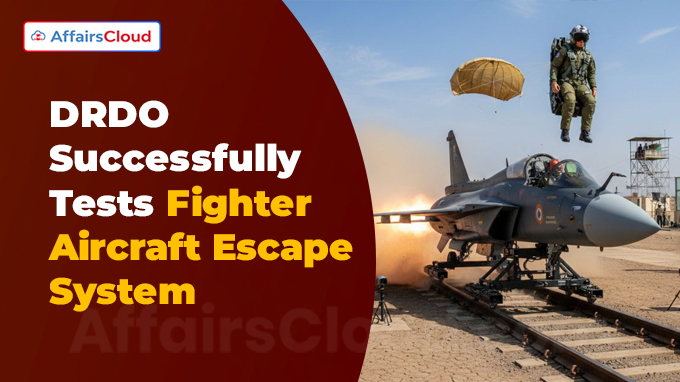

On December 2, 2025, Defence Research and Development Organization (DRDO), under Ministry of Defence (MoD), successfully conducted the high-speed rocket-sled test of a fighter aircraft’s emergency escape system at a controlled velocity at the Rail Track Rocket Sled (RTRS) facility at Terminal Ballistics Research Laboratory (TBRL) in Chandigarh, Haryana.
- The test achieved a controlled velocity of 800 kilometres per hour(km/h) and successfully validated all key functions, canopy severance, ejection sequencing, and full aircrew recovery.
- This achievement positions India among the few nations with the capability to conduct advanced in-house escape system testing.
Exam Hints:
- What? Fighter Aircraft’s Escape System was tested
- Who? DRDO (MoD), ADA, HAL
- Test: High-speed rocket-sled test
- Where? At TBRL in Chandigarh (Haryana)
- Validation: Canopy severance, Ejection sequencing, and Full aircrew recovery
- Significance: India placed one among the countries capable of advanced in-house escape system testing
About Fighter Aircraft Escape System Test:
Configuration: The trial employed a dual-sled setup carrying the fore-body of a fighter jet, specifically the Light Combat Aircraft (LCA) Tejas fore-section, to accurately simulate real flight conditions on the ground.
Pilot Simulation: An instrumented Anthropomorphic Test Dummy simulated a pilot, recording critical loads, moments, and accelerations experienced during ejection.
Test Output: It includes:
- Canopy Severance System (CSS) safely blew away the cockpit canopy at high speed.
- Ejection sequencing occurred in the correct order with precise timing such as canopy jettison, seat ejection, and parachute deployment.
- Test dummy endured forces within safe limits, indicating the system ensures pilot safety.
Imaging & Data Capture: The entire sequence, including the canopy fragilisation pattern, was precisely recorded using onboard and ground-based imaging systems.
Collaboration: The test was conducted in collaboration with Hindustan Aeronautics Limited (HAL) and Aeronautical Development Agency (ADA) under the MoD.
Monitoring: The test was monitored using onboard and ground-based cameras and witnessed by the officials from the Indian Air Force (IAF) and Institute of Aerospace Medicine (IAM), under the MoD.
About High-Speed Rocket-Sled Test:
Overview: It is an advanced ground-based experiment used to simulate extreme conditions, such as those experienced by aircraft or spacecraft during flights, crashes, or ejections.
- In this test, a sled mounted on rails is propelled at very high speeds using rockets, simulating the rapid acceleration or deceleration experienced by vehicles or personnel.
Purpose: To verify aircraft escape systems, ensure aircrew safety under extreme forces, test precise system reliability, and support Research and Development (R&D) for advanced vehicle safety.
About Defence Research and Development Organization(DRDO):
DRDO was established in 1958 through the merger of the Technical Development Establishment and the Directorate of Technical Development & Production of the Indian Ordnance Factories with the Defence Science Organisation.
- Dr. Daulat Singh (D.S.) Kothari became the first Director-General (DG) of DRDO.
- It is fully funded and owned by the Government of India (GOI)
Director-General (DG) – Dr. Samir. V. Kamat
Headquarters – New Delhi, Delhi
Established – 1958