
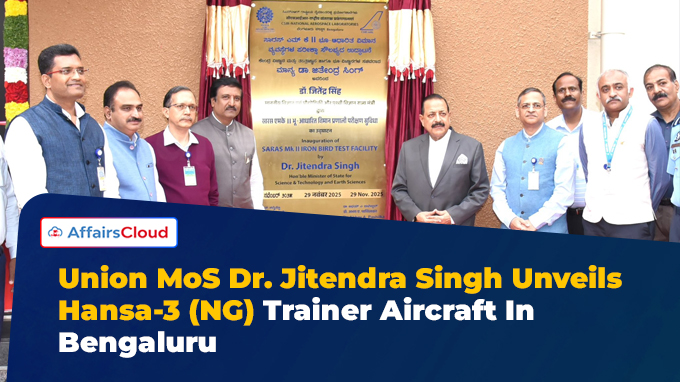

In November 2025, Union Minister of State (MoS) (Independent Charge, IC) Dr. Jitendra Singh, Ministry of Science & Technology (MoS&T) unveiled the production version of Hansa-3 (NG) trainer aircraft, India’s 1st indigenous all-composite airframe two-seater aircraft
- During an event held at Council of Scientific& Industrial Research-National Aerospace Laboratories (CSIR-NAL) in Bengaluru, Karnataka.
- Apart from this aircraft, Union MoS reviewed the progress of SARAS Mk-II and inaugurated various other aerospace facilities like: SARAS Mk-II Iron Bird Facility; High Altitude Platforms (HAPs) Airframe Fabrication Facility and NaviMet.
Exam Hints:
- What? Launch of production version of Hansa-3 (NG) Aircraft
- Launched by: Union MoS Dr. Jitendra Singh
- Where? CSIR-NAL (Bengaluru, Karnataka)
- Other Key Highlights:
- Review the progress of SARAS Mk-II (19 seater LTA);
- Inauguration of SARAS Mk-II Iron Bird Facility; HAPs Airframe Fabrication Facility and NaviMet
- Signing of MoU: Between SDAL and CSIR-NAL
- Purpose of MoU: Development of 150 kg class LM-UAV
About Hansa-3 (NG):
Background: It was 1st designed and developed by the CSIR-NAL in the early 1990s.
- In April 2025, CSIR-NAL formalized the Transfer of Technology (ToT) agreement with M/s Pioneer Clean Amps Private Limited for the manufacturing of HANSA-3 (NG) aircraft.
Purpose: This aircraft is designed to meet the expanding demand for Private Pilot License (PPL) and Commercial Pilot License (CPL) training.
Key Projection: India is expected to need nearly 30,000 pilots over the next 20 years.
Manufacturing Facility: Pioneer Clean Amps Pvt. Ltd. will set up a 150 crore manufacturing facility in Kuppam, Andhra Pradesh (AP), with annual production of a maximum 100 aircrafts.
Other Key Initiatives:
SARAS Mk-II: It is a 19-seater Light Transport Aircraft (LTA), designed for both civilian and military purposes.
- Some of the key features of the aircraft are: pressurized cabin, digital avionics, a glass cockpit and weight reduction optimisations.
- The aircraft is expected to bolster regional connectivity under the Ude Desh ka Aam Naagrik (UDAN) scheme and reduce India’s dependence on foreign-made small passenger aircraft.
Iron Bird Facility: Union MoS also inaugurated an Iron Bird Facility for SARAS Mk-II. This new facility is an important platform for full-system integration, ground testing, and validation of major aircraft subsystems.
- It aimed to reduce flight-test risks and accelerate development times, enabling early detection of any design and software related issues.
HAP Facility: He also inaugurated an airframe fabrication manufacturing facility for HAP, solar-powered unmanned aircraft capable of flying above 20 kilometers (kms) for long-endurance missions.
- The Government of India (GoI) has planned the 1st full-scale HAP flight in 2027, after the successful tests of a sub-scale vehicle that achieved 7.5 km altitude and more than 10 hours (hrs) endurance.
- Currently, few countries such as: the United States of America (USA), the United Kingdom (UK), Germany, South Korea, New Zealand, and Japan, manufacture this solar-powered unmanned aircraft.
NaviMet System: Additionally, Union MoS Dr. Singh inaugurated the NaviMet system at Hindustan Aeronautics Limited (HAL) Airport (Bengaluru).
- At present, over 175 DRISHTI, Automated Weather Observing System (AWOS), and NaviMet systems developed by CSIR-NAL, are deployed across civil and defence airfields in India.
Signing of MoU: During the event, CSIR-NAL signed a Memorandum of Understanding (MoU) with M/s Solar Defence & Aerospace Limited (SDAL) for the development of the indigenous150 kilogram (kg) class Loitering Munition- Unmanned Aerial Vehicle (LM-UAV).
- As per the MoU, SDAL and CSIR-NAL will jointly develop the LM-UAV, which will be powered by a Wankel engine designed by NAL.
- For the initial phase, NAL, which works under the CSIR, will transfer technology for its 30 horse power (hp) Wankel engine to manufacture kamikaze drones.
- LM-UAV will have a strike range of 900 kms, endurance of 9 hours (hrs) and service ceiling of 5 kms.
- LM-UAV will be equipped with a very low Radar Cross Section (RCS) and will be designed to operate in Global Positioning System (GPS)-denied environments.
- It will also feature an Artificial Intelligence (AI)-enabled payload, offering Detection, Recognition, and Identification (DRI)capabilities in real-time intelligence and situational awareness.
About Council of Scientific& Industrial Research-National Aerospace Laboratories (CSIR-NAL):
Director- Dr. Abhay Anant Pashilkar
Headquarters- Bengaluru, Karnataka
Established-1959